Financial transparency
A first cost corridor and TCO perspective are available for investment decisions.
Last updated on


Fast, image-first tour of the STACKIT Migration Framework for trade-fair booths and quick briefings: one visual per phase and module, looping automatically.
Start at the tourist information office, prepare at basecamp, and follow the path to migration, operations, and innovation. Ask where your organization stands today. These six illustrated stations are a simplified story, not the formal framework phases.

Frame Assess as the fast, low-commitment phase that builds an initial fact base and qualifies migration intent before deeper design work starts.
Assess is the first phase of the STACKIT Migration Framework. It creates a fact-based baseline for migration decisions before architecture design and wave delivery begin.
The phase combines technical discovery with commercial and organizational alignment so that later migration work starts with clear priorities and transparent assumptions.
Assess typically starts when a migration initiative has strategic sponsorship but no decision-ready baseline yet.
Assess is completed when stakeholders can approve moving into Design and Mobilize with a shared understanding of cost, risk, and delivery feasibility.
Assess reduces uncertainty early and aligns business and IT before large implementation effort is committed.
Financial transparency
A first cost corridor and TCO perspective are available for investment decisions.
Readiness clarity
Gaps in technology, governance, capabilities, and operating model are visible early.
Stakeholder alignment
Leadership, delivery teams, and technical owners align on goals, scope, and expectations.
Risk reduction
Key assumptions and migration constraints are documented before target design starts.
At the end of Assess, the program should have:
Assess does not finalize the full target architecture. Instead, it creates the validated input needed to start detailed design, migration-wave planning, and factory setup in the next phase.
Assess technical, process, personnel, financial, and governance readiness, then assign every gap to an owner and migration-wave gate.
Position Design and Mobilize as the phase carrying most of the framework's substance: it turns Assess signals into an executable, factory-ready delivery plan.
Design and Mobilize is the planning and enablement phase between Assess and Migrate. It translates baseline findings into executable target designs, governance, and migration factory readiness.
The phase ensures that migration delivery starts with clear architectural decisions, security controls, team setup, and wave planning.
This phase starts after Assess confirms migration scope, readiness, and commercial direction.
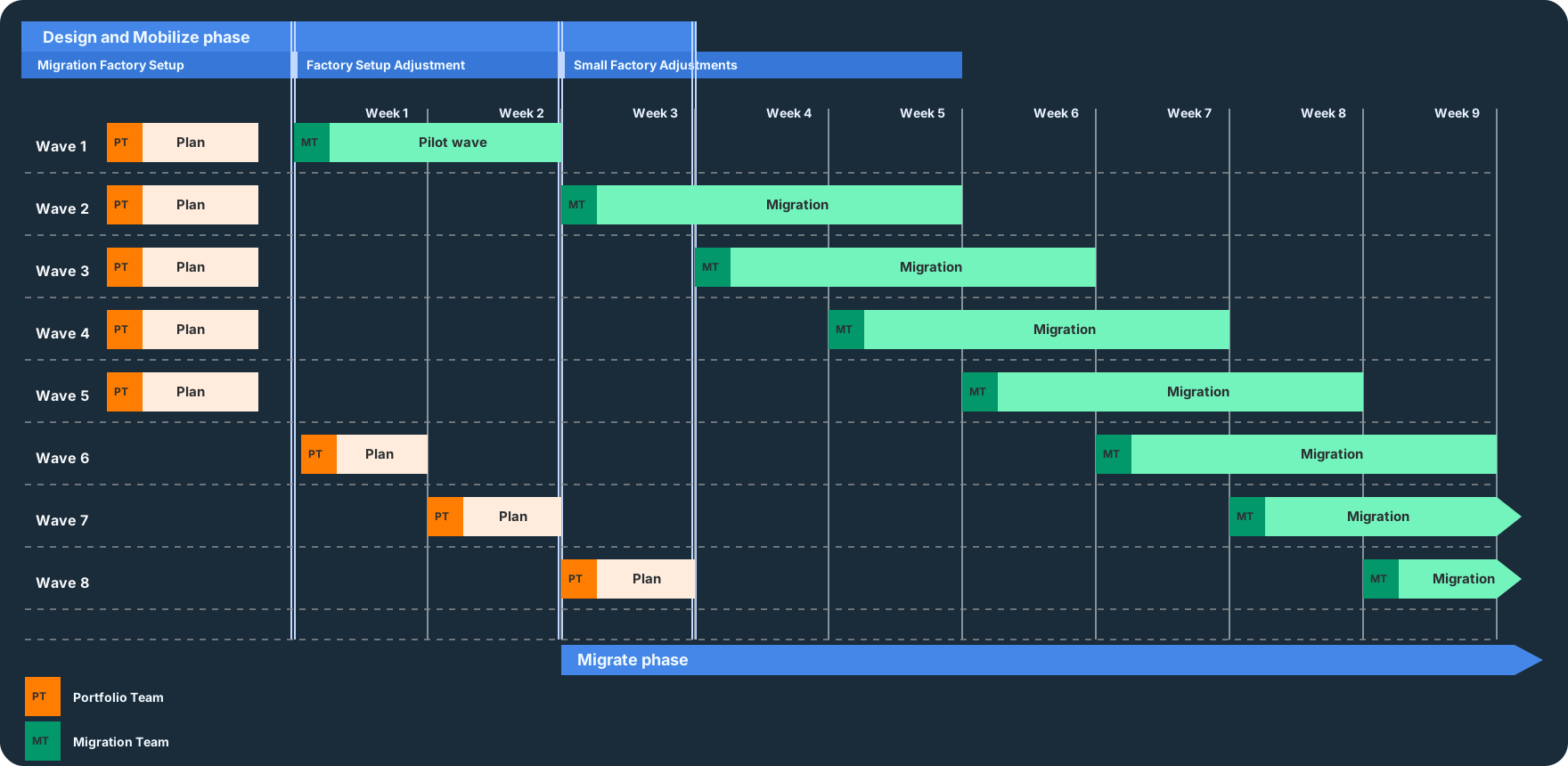
Design and Mobilize is complete when migration teams can begin wave run with stable inputs, controls, and responsibilities.
This phase turns strategy into delivery readiness and prevents uncontrolled migrations.
Architecture readiness
Target patterns and migration paths per workload are defined and validated.
Factory enablement
Roles, processes, tooling, and runbook governance are established before scale-up.
Security by design
Security and compliance requirements are integrated into design and planning from the start.
Execution confidence
Waves are sequenced with dependency awareness and operational feasibility.
At the end of Design and Mobilize, the program should have:
Design and Mobilize can overlap with early migration waves. As soon as the first waves and runbooks are validated, Migrate begins and delivery continues iteratively while planning is refined for upcoming waves.
Use this interactive map to explore the STACKIT service portfolio. Select a product or access tool to open its current documentation or related Cloud Framework asset.
The map is a navigation aid rather than a lifecycle commitment. Check each linked product page for current regions, availability, service levels, and release status.
Browse all STACKIT product documentation Open the documentationR-strategy explains how migration is run. This page adds the workload lens and clarifies what is migrated. It is intentionally solution-neutral and focuses on transparent categorization, feasibility boundaries, and decision context.
Application runtime migration
Migration of complete application runtimes across VM and platform targets, including dependencies, cutover behavior, and operating handover.
Container platform migration
Migration between Kubernetes platforms with separate treatment of stateless and stateful workload profiles.
Data migration
Migration of large file volumes, databases, and data platform workloads with explicit consistency, performance, and integrity boundaries.
Identity and access migration
Migration of IAM foundations such as SSO, federation, roles, service accounts, and permission models.
Network and connectivity migration
Migration of routing, DNS, firewall rules, segmentation, private connectivity, and cross-environment communication paths.
Integration and API migration
Migration of API contracts, messaging, eventing, and integration endpoints across source and target estates.
Security and compliance controls migration
Migration of controls, evidence chains, key material, and audit requirements required for regulated production readiness.
Operations and observability migration
Migration of monitoring, alerting, logging, incident workflows, and service-level operations baselines.
Delivery and resilience migration
Migration of CI/CD pipelines, automation controls, backup chains, and disaster recovery capabilities.
STACKIT supports migration paths from AWS and Azure across application runtimes, data, network, identity, operations, and delivery. Select the target path for each workload according to its architecture, data profile, availability requirements, and operating model.
| Use case | Migration capability to STACKIT |
|---|---|
| Landing zone migration | AWS account and Azure subscription structures, network segmentation, identity and access controls, security policies, logging, monitoring, and governance guardrails are mapped to a STACKIT landing zone before application migration waves begin. The STACKIT Landing Zone Accelerator provides a reusable, automated foundation for implementing these controls consistently at scale. |
| VM-based applications | AWS EC2 and Azure VM workloads can be migrated to STACKIT Compute Engine, including operating systems, middleware, applications, configurations, and connected data. |
| VM estates with high availability requirements | Tool-assisted Relocate migration supports continuous replication, controlled validation, and planned cutover for large VM landscapes and repeatable migration waves. |
| Container and Kubernetes workloads | AWS EKS, Azure AKS, and self-managed Kubernetes clusters can move to STACKIT Kubernetes Engine. Stateless applications can be redeployed declaratively; stateful applications can use backup and restore or data replication with staged traffic migration. |
| PaaS and web applications | Applications using common runtimes such as Java, Node.js, Python, or Ruby can run on STACKIT Cloud Foundry when they fit the platform model. |
| Databases and data platforms | Self-managed and cloud-based databases can move to STACKIT Managed Database Services or initially to Compute Engine instances, using export/import, replication, and controlled cutover procedures. |
| Object and file storage | AWS S3 and Azure Blob Storage can move to STACKIT Object Storage. AWS EFS, Azure Files, and NFS-based file systems can move to STACKIT File Storage through initial copy, delta synchronization, and final consistency cutover. |
| Identity and access management | AWS IAM, Azure RBAC, and Microsoft Entra-based access models can be mapped to STACKIT roles, permissions, service accounts, and federation. |
| Network, DNS, and connectivity | AWS VPCs and Azure VNets can be mapped to STACKIT Network Areas, routing, security groups, load balancing, DNS, and site-to-site VPN connectivity. |
| Integration, messaging, and APIs | APIs, integration endpoints, and messaging workloads can be migrated with their contracts, security mechanisms, and cutover sequence. STACKIT RabbitMQ supports AMQP- and RabbitMQ-based patterns. |
| Security, compliance, and operations | Secrets, keys, audit requirements, logging, monitoring, alerting, backup, and operational processes are established as part of the target environment before go-live. |
| CI/CD and delivery | Deployment pipelines, infrastructure automation, and source control can move to STACKIT Git, Terraform or OpenTofu, CLI, APIs, and suitable image-management processes. |
For the service-by-service target mapping, see AWS and Azure Target Service Mappings.
Use these dimensions to categorize requests before selecting implementation variants:
Mandatory boundaries:
Mandatory boundaries:
Mandatory boundaries:
Mandatory boundaries:
Mandatory boundaries:
Mandatory boundaries:
Mandatory boundaries:
Mandatory boundaries:
Mandatory boundaries:
The implementation details are maintained in dedicated asset pages. This keeps the overview page category-focused and allows concrete templates to evolve independently.




The Design module decides how an application should run on STACKIT before migration runs start. This page focuses on application-level target architecture decisions, not on landing-zone foundation topics.
For each application, the target design should answer these core questions:
Use this as a practical orientation for application design:
Do not choose based on team habit only. Choose based on measurable requirements, operating capacity, and life cycle goals.
VM runtime (IaaS)
Best for low-change migrations and components needing OS-level control, custom agents, or strict legacy compatibility.
Kubernetes runtime (PaaS-like ops model)
Best for containerized workloads needing controlled scalability, release automation, and standardized platform operations.
Cloud Foundry runtime (PaaS)
Best when teams prioritize developer productivity and fast app delivery over low-level platform control.
Static delivery with Object Storage/CDN
Best for frontend/static workloads with high distribution needs and minimal backend runtime complexity.
SaaS replacement path
Best when process fit and standard capabilities provide higher value than migrating and operating the existing application stack.
VM pattern with operational baseline
Spring Boot on VM with Application Load Balancer, observability integration, and backup strategy.
Kubernetes platform pattern
Spring Boot on SKE with managed data services, object storage, secrets handling, and messaging.
Static delivery with CDN option
Static content delivery from Object Storage with optional CDN acceleration for internet-facing use cases.
Hybrid connectivity pattern
Workload access through VPN and central firewall controls for enterprise network integration.
Cloud Foundry pattern
Spring Boot on Cloud Foundry with backing services such as Redis and RabbitMQ.
Use the pattern cards as candidate architectures and select one explicit target per application. Do not combine multiple patterns unless coexistence is a deliberate transitional state.
Use these architecture assets as concrete design references.




Use the architecture assets to select and justify a target pattern, then use the runbook assets to run the migration path.
The Design module decides how an application should run on STACKIT before migration runs start. This page focuses on application-level target architecture decisions, not on landing-zone foundation topics.
For each application, the target design should answer these core questions:
Use this as a practical orientation for application design:
Do not choose based on team habit only. Choose based on measurable requirements, operating capacity, and life cycle goals.
VM runtime (IaaS)
Best for low-change migrations and components needing OS-level control, custom agents, or strict legacy compatibility.
Kubernetes runtime (PaaS-like ops model)
Best for containerized workloads needing controlled scalability, release automation, and standardized platform operations.
Cloud Foundry runtime (PaaS)
Best when teams prioritize developer productivity and fast app delivery over low-level platform control.
Static delivery with Object Storage/CDN
Best for frontend/static workloads with high distribution needs and minimal backend runtime complexity.
SaaS replacement path
Best when process fit and standard capabilities provide higher value than migrating and operating the existing application stack.
VM pattern with operational baseline
Spring Boot on VM with Application Load Balancer, observability integration, and backup strategy.
Kubernetes platform pattern
Spring Boot on SKE with managed data services, object storage, secrets handling, and messaging.
Static delivery with CDN option
Static content delivery from Object Storage with optional CDN acceleration for internet-facing use cases.
Hybrid connectivity pattern
Workload access through VPN and central firewall controls for enterprise network integration.
Cloud Foundry pattern
Spring Boot on Cloud Foundry with backing services such as Redis and RabbitMQ.
Use the pattern cards as candidate architectures and select one explicit target per application. Do not combine multiple patterns unless coexistence is a deliberate transitional state.
Use these architecture assets as concrete design references.
Use the architecture assets to select and justify a target pattern, then use the runbook assets to run the migration path.
In this framework, the runbook is produced in the Design phase. It captures the intended run path, controls, rollback logic, and handover criteria per migration strategy.
Migration Factory Setup does not create the first runbook version. It operationally hardens, standardizes, and validates Design runbook drafts for wave-scale delivery.
Every migration runbook should include these chapters:
Executable
Verifiable
Validation points define clear pass/fail criteria and required evidence.
Recoverable
Rollback path is complete, timed, and linked to explicit trigger conditions.
Handover-ready
Use this concrete sample runbook asset for a classic Rehost case (Spring Boot to VM):
In this framework, the runbook is produced in the Design phase. It captures the intended run path, controls, rollback logic, and handover criteria per migration strategy.
Migration Factory Setup does not create the first runbook version. It operationally hardens, standardizes, and validates Design runbook drafts for wave-scale delivery.
Every migration runbook should include these chapters:
Executable
Verifiable
Validation points define clear pass/fail criteria and required evidence.
Recoverable
Rollback path is complete, timed, and linked to explicit trigger conditions.
Handover-ready
Use this concrete sample runbook asset for a classic Rehost case (Spring Boot to VM):
Account governance defines how you separate environments, teams, and responsibilities in a way that remains auditable and scalable.
It creates the organizational control plane for migration waves: where workloads are hosted, who owns which scope, and how new projects are added without bypassing guardrails.
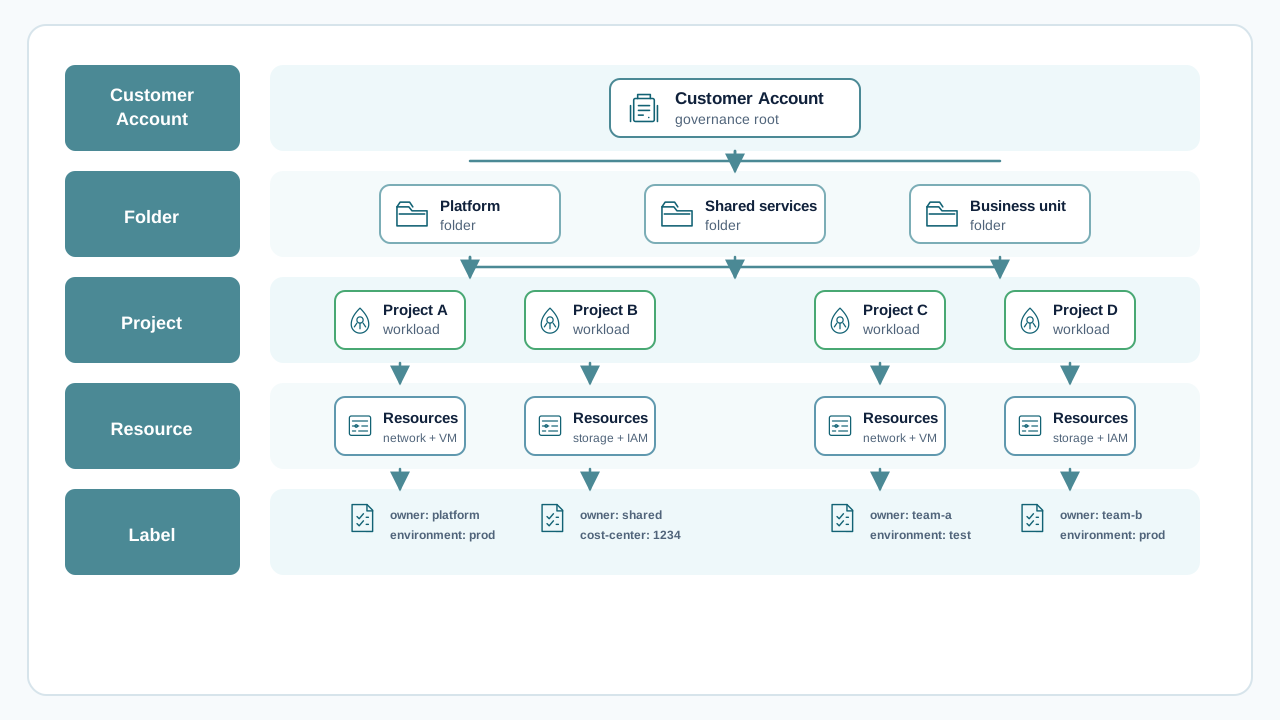
Governance and Decision Making assigns decision rights and escalation paths for these account, folder, and project boundaries.
Network architecture defines how workloads communicate securely, how traffic is segmented, and how central connectivity services are governed across shared and project-specific landing zones.
In most enterprise migrations, this topic is less about individual subnets and more about operating a controlled connectivity model over time: who connects which project, via which paths, and under which guardrails.
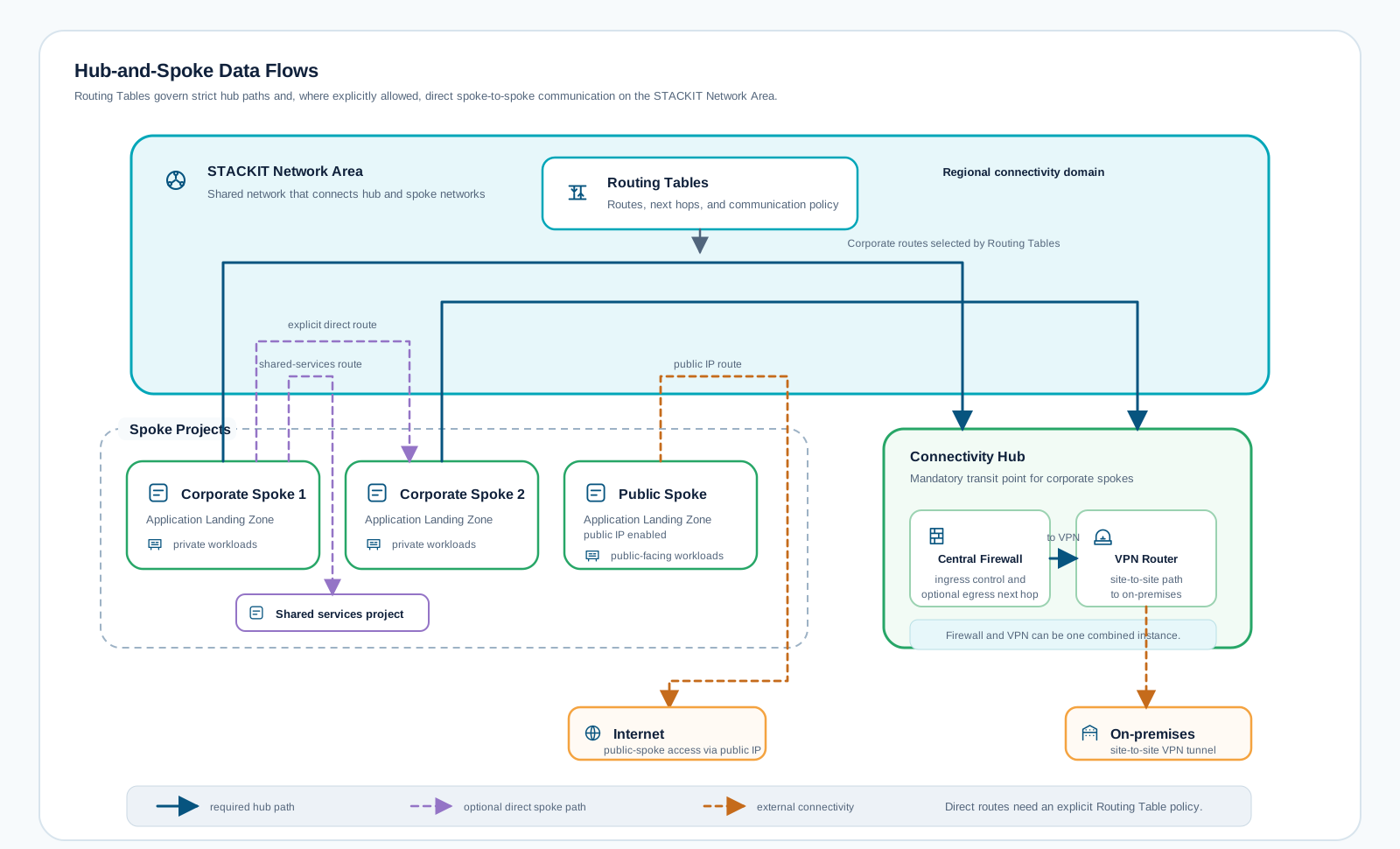
Confirm the product connectivity boundaries before choosing a topology. Network Area scope, route precedence, and VPN gateway behavior constrain the design; they do not replace the workload connectivity matrix or security approval.
The source shows pictures here that this page leaves out (1). See them in Concepts
The STACKIT Network Area (SNA) allows projects within an organization to be connected to each other on a network level. This makes it possible to connect various resources of the projects within an SNA and also simplifies the connection with on-prem environments (hybrid cloud).
An SNA project differs from a public project in the fact that it is connected to an internal transfer network. When creating a network in a SNA project, the address range is defined using the specified prefix length from the network ranges of the SNA. To make the connectivity within the SNA projects available, the project router gets connected to the SNA transfer network. When editing the networks of SNA projects, the routing table of all project routers is automatically adjusted, no manual adjustment is necessary. Access control at network level is carried out exclusively by security groups, all incoming traffic is denied by default.
SNA is a global resource which you need to enable for the regions you want to use it in. Currently traffic between regions is only possible via the public internet. Private connectivity between regions inside of an SNA is planned for the future.
Example topology of an SNA with 2 projects:
This section is copied from the STACKIT docs automatically, several times a day. It cannot be changed here. Changes belong in the STACKIT docs.
Routing tables consist of different types of routes serving different purposes and having a different priority in the overall routing context. Route types with a higher priority value are preferred over lower priority ones if they have the same prefix length. If routes of the same route type have the same prefix length, equal-cost-multi-path (ECMP) is performed.
| priority | route type | description |
|---|---|---|
| 4 | system routes | System routes are automatically generated routes for connectivity between projects inside an SNA. System routes are enabled by default for routing tables but can be disabled to manage traffic and isolation within a network environment. |
| 3 | service routes | Service routes are routes which are added by a STACKIT service to reach it. Service routes are always enabled and can’t be disabled/removed by the user directly. |
| 2 | static routes | Static routes are routes which are added by a user. They can have different next-hops such as an IP-address, black hole or the internet. |
| 1 | dynamic routes | Dynamic routes are routes which are learned through a dynamic routing protocol like BGP. Dynamic routes are enabled by default for routing tables but can be disabled. |
This section is copied from the STACKIT docs automatically, several times a day. It cannot be changed here. Changes belong in the STACKIT docs.
A Virtual Private Network (VPN) with STACKIT creates a secure, encrypted connection over the internet between your remote network and your STACKIT Network Area (SNA). This secure tunnel allows data to be transmitted safely, protecting it from eavesdropping, interception, or unauthorized access.
With STACKIT VPN, you can securely connect to your STACKIT Network Area, enabling access to its resources as if you were directly connected to the remote network. This capability is particularly useful for accessing services, applications, and data within the SNA from remote locations, ensuring both privacy and security in all communications.
A STACKIT VPN typically consists of two key components; the VPN gateway and the VPN connection:
STACKIT VPN is an essential tool for securely connecting distributed resources, enabling remote access to cloud-based services while maintaining the integrity and privacy of your data within the STACKIT cloud environment.
This section is copied from the STACKIT docs automatically, several times a day. It cannot be changed here. Changes belong in the STACKIT docs.
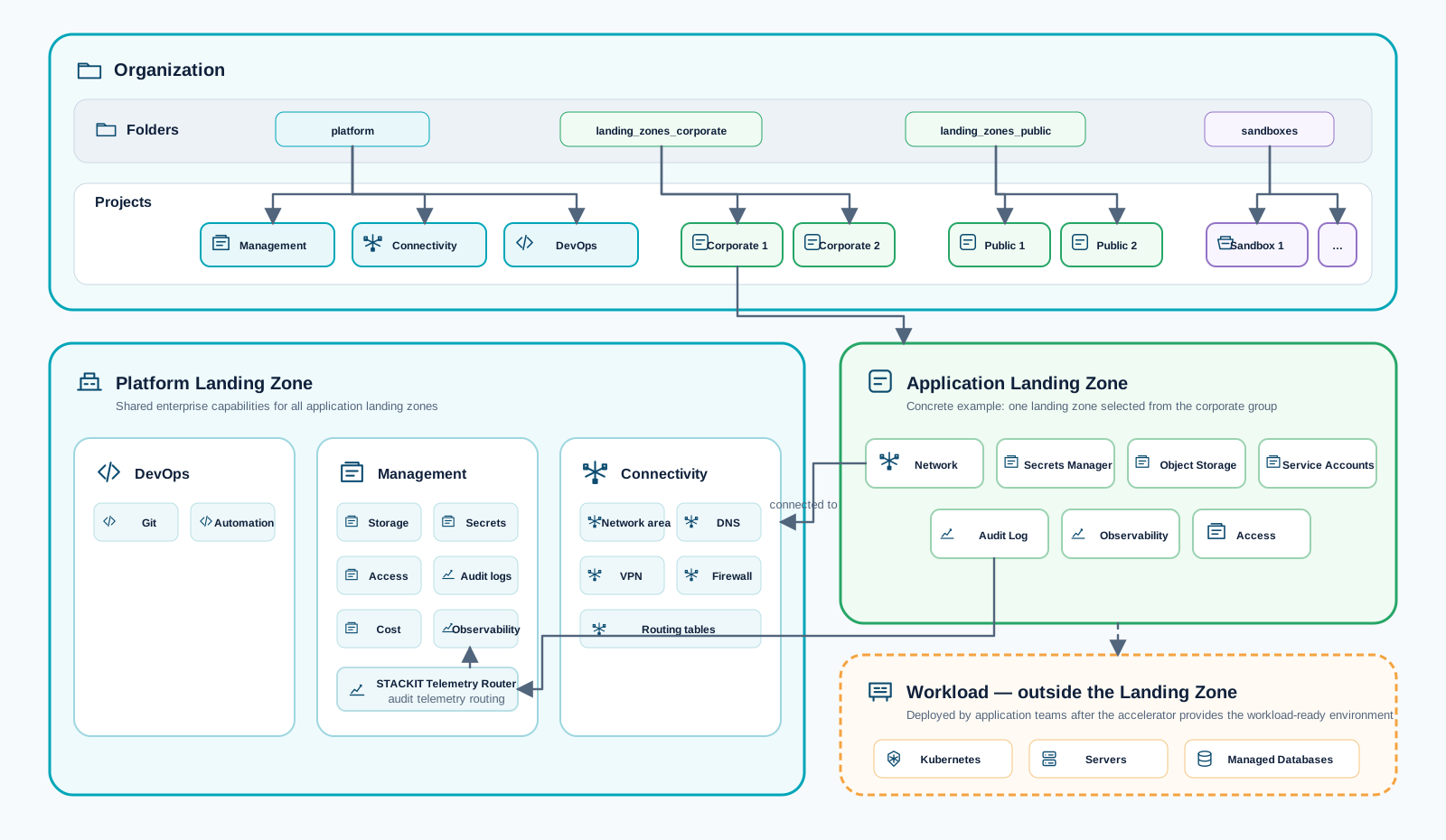
Prepare migration teams through CCoE ownership, role-based STACKIT University learning, trusted documentation, and validated AI guidance.
Keep this as concise as Assess and focus on the end-to-end factory flow that runs every wave to completion.
This module executes the actual migration delivery in the Migration Factory. By this point, design decisions are approved, landing zones are ready, and wave plans are defined.
Migrate focuses on repeatable technical run patterns for:
Migrate starts after Design and Mobilize has produced implementable inputs:
Reference modules:
Runbook evidence
Completed runbook records, decision logs, and rollback checkpoints for each migrated workload.
Cutover report
Time-stamped cutover outcome with acceptance results, defects, and mitigation actions.
Operational baseline
Initial monitoring, alerting, ownership, and incident procedures in the target setup.
Optimize backlog
Structured list of rightsizing, performance, and cost measures for post-cutover tuning.
Post-cutover care can overlap with Optimize after cutover, but it is handled in the Run phase.
Keep this concise: Optimize turns freshly migrated workloads into cost- and performance-tuned steady-state services.
Optimize starts when workloads run on STACKIT and real operating data is available. The module converts post-cutover observations into measurable improvements for performance, stability, and cost efficiency.
Optimize is not a one-time task. It is an iterative cycle that can overlap with early stabilization and post-cutover care.
Many right-sizing and tuning decisions are only reliable under real load patterns. After cutover, teams can use production telemetry to separate assumptions from actual behavior.
Optimization decisions should be based on runtime evidence, not assumptions. For practical implementation, combine workload telemetry, alerting, and controlled infrastructure changes.
For Replatform workloads on Kubernetes, optimization spans multiple layers and should be coordinated as one control loop.
Primary inputs
Cutover reports, incident trends, SLO measurements, telemetry baselines, and cost reports.
Optimization outputs
Prioritized improvement backlog, validated tuning changes, and updated runbook standards.
Governance outcome
Clear trade-off decisions between performance, resilience, and cost with documented ownership.
Close the journey briefly with the Run phase module map so the audience sees where migration outcomes ultimately land.
Run is the target state of the migration journey: workloads run on STACKIT with defined ownership, stable operations, and measurable service quality.
The phase starts with post-cutover stabilization and extends into long-term cloud operations. It is where migration outcomes are translated into durable operational performance.
Run is not just a follow-up activity. It is the strategic destination behind migration run. For many programs, the practical objective is clear: maximize the share of workloads that run reliably in a “Runs on STACKIT” operating state.
Run connects to Migrate through Hypercare and extends the Target Operating Model into real day-to-day service operations.
Operating Model Handover is anchored in Migrate and can overlap with migration waves before Run starts.
Run combines short-term stabilization and long-term service operations. The following model visualizes the intended flow from migration handoff to stable day-2 operations.
The Run model uses four semantic streams to clarify ownership and purpose:
Bridge from project to operations
Hypercare ensures unresolved migration topics are stabilized before they become recurring incidents.
Clear ownership and support model
Defined responsibilities for incidents and service requests reduce friction and escalation loops.
Operational resilience
Monitoring, observability, and runbook maturity improve reliability and recovery behavior.
Sustained value realization
Continuous service improvement keeps performance, cost, and user outcomes aligned with business goals.
At the end of the initial Run establishment, teams should have:
One form on the Marketplace assigns you a dedicated Partner Manager, and a 30-to-45-minute discovery call establishes mutual fit before either side invests engineering or legal time. Bring a business owner and a technical lead — the call covers both.
The ISV Factory Framework provides a structured, end-to-end journey designed to seamlessly guide software vendors from initial engagement to full marketplace readiness. Divided into clear phases — ranging from initial onboarding and technical validation to quality assessment and marketplace placement — this framework ensures your solution achieves maximum performance, security, and integration with STACKIT. Explore each step below to understand the key milestones and requirements along your path.
The overview below summarizes the ISV journey from first contact to a live Marketplace listing. It helps vendor and STACKIT teams build a shared understanding of deliverables, dependencies, and expected outcomes across all ten phases.
The KickOff phase transitions the partnership from initial qualification into concrete strategy execution. In this step, both teams align on the business model, compute resources, go-to-market approach, and support programs to ensure a viable, scalable product release on the STACKIT Marketplace.
The primary goal of the KickOff meeting is to validate mutual financial and technical feasibility before signing formal contracts.
To construct a realistic business case and define the resource baseline, the ISV provides key parameters regarding product architecture and commercial goals:
| Category | Required information | Purpose |
|---|---|---|
| Pricing & Licensing Model | SaaS subscription, usage-based, BYOL (Bring Your Own License), or tiered pricing. | Defines transaction handling on the STACKIT Marketplace. |
| Resource Footprint | Estimated average and peak compute (vCPU, RAM), storage (NVMe/S3), network bandwidth, and managed services (e.g., STACKIT Postgres/Kubernetes). | Calculates estimated STACKIT infrastructure costs and margin models. |
| Target Audience & Verticals | Specific industries (e.g., public sector, healthcare, finance) or enterprise segments. | Aligns GTM campaigns and compliance/certification requirements. |
| Sales & Revenue Expectations | Projected onboarding pipeline and expected customer sign-ups over 12–24 months. | Validates business viability and eligibility for STACKIT funding programs. |
During the KickOff, both parties agree on the structure of the joint go-to-market approach:
1. Co-Selling & Referral
2. Marketplace Resell
STACKIT supports qualifying ISVs during the onboarding journey to reduce initial development risks:
At the end of the KickOff, clear ownership is assigned for the immediate next phase:
For questions on the business case, funding programs, or go-to-market models, contact your
dedicated STACKIT Partner Manager or the ISV Factory team at
isv-sales@digits.schwarz.
The Technical Proof of Concept (PoC) phase is where your architectural planning becomes reality. The goal of this phase is to deploy a working version of your application on STACKIT to validate technical feasibility, performance, and cost-efficiency before moving toward a production-ready state.
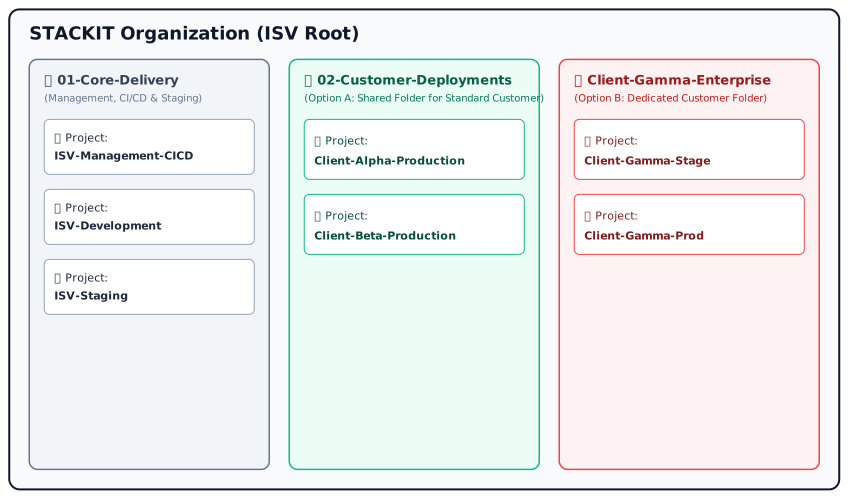
A critical decision before rolling out your infrastructure is defining your tenant strategy. This decision heavily impacts your STACKIT Organization, Folder, and Project structure:
Multitenant Strategy: Multiple customers share the same infrastructure and application instance, separated logically.
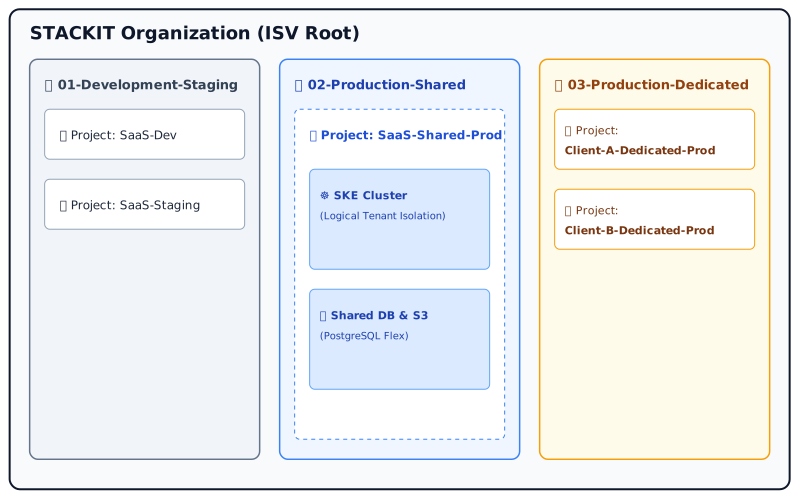
Customer Dedicated (Single Tenant): Each customer receives an isolated STACKIT Project and infrastructure environment.
Accelerate your setup. To support a fast, automated, and standardized rollout of your cloud environment, STACKIT provides Infrastructure-as-Code (IaC) assets:
When building your PoC, you must design for growth, stability, and security:
Once you have defined your deployment model, isolation strategy, and resilience requirements, translate these specifications into a formal Architectural Blueprint.
Mapping your software components (microservices, stateful data, caching layers, external interfaces) directly to STACKIT services — such as SKE, PostgreSQL Flex, Object Storage and STACKIT Network Area — creates a clear target architecture. This blueprint serves as the essential foundation for precise infrastructure cost modeling and subsequent automation via IaC.
With your Architectural Blueprint defined, model and track your resource consumption against your initial business case estimations:
To achieve high reliability and low operational overhead, manual infrastructure provisioning via the portal should be avoided for production-grade software. Infrastructure as Code (IaC) is the state-of-the-art industry standard for cloud-native deployment.
Using declarative tools ensures your infrastructure is repeatable, version-controlled, and audit-ready:
A standardized Continuous Integration / Continuous Deployment (CI/CD) pipeline automates the lifecycle of both your infrastructure and application workloads.
terraform validate, tflint) and scan container images for vulnerabilities — either by running Trivy directly as a pipeline step, or by relying on the vulnerability scans the STACKIT Container Registry performs on pushed images. Running both gives you a gate in the pipeline and continuous rescanning of images already stored.terraform plan for automated verification, followed by terraform apply to provision or update STACKIT resources in the target PoC environment.kubectl apply steps, as they leave no reconcilable desired state. PaaS applications are deployed via Cloud Foundry (cf push).The PoC phase is complete when the following milestones are verified:
Throughout the PoC phase, use the following resources to support your development:
Need assistance? If you encounter technical blockers during your PoC, contact your Partner
Manager or the ISV Factory team at isv-sales@digits.schwarz.
The European Sovereign Stack Standard (ES³) is STACKIT’s digital sovereignty program. It makes the otherwise vague concept of digital sovereignty objectively measurable, in a market where “sovereignty washing” and vague marketing promises are common. Its operational engine is the Sovereignty Maturity Level (SML) Framework, an auditable assessment framework whose criteria have been verified by the independent auditing firm BDO.
The framework follows three guiding principles:
The SML framework builds on the eight sovereignty objectives of the official EU Cloud Sovereignty Framework (CSF) and adds a ninth, future-critical dimension: Artificial Intelligence.
| ID | Dimension | What it assesses |
|---|---|---|
| SML 1 | Strategic | Corporate governance architecture, ownership dependencies, transparency of ownership structures, and executive oversight of service substitution and exit readiness. |
| SML 2 | Legal & Jurisdictional | Applicable legal frameworks, geographic processing boundaries, and legal protection against extraterritorial third-party claims or conflicting access requests. |
| SML 3 | Data | Customer-controlled access management, cross-environment data portability, purpose-bound usage constraints, and long-term cryptographic resilience. |
| SML 4 | Operational | Allocation of day-to-day operational responsibility, restriction and auditing of privileged access, autonomous incident response, and disaster recovery. |
| SML 5 | Supply Chain | Transparency of subprocessors and software components (SBOM), vendor risk governance, critical dependency mitigation, and vendor substitution workflows. |
| SML 6 | Technology | Deployment within approved geographic boundaries, adoption of open standards against vendor lock-in, architectural transparency, and component portability. |
| SML 7 | Security & Compliance | Least-privilege identity and access control, lifecycle data encryption, customer visibility into security logs, and isolation of high-risk operational tasks. |
| SML 8 | Environmental Sustainability | Infrastructure energy dependency profiles, hardware and cooling supply-chain exposure, environmental risk planning, and sustainability metric disclosure. |
| SML 9 | AI | Corporate accountability models, system explainability, reliance on external software providers, and protection of training data and model components. |
Each dimension is assessed on three mandatory implementation levels, so a requirement is never satisfied on paper alone:
| Level | Short form | Description |
|---|---|---|
| 1 Initial | Ad hoc, not standardized | Heavy reliance on external providers. Processes are reactive, digital dependencies are not managed and not embedded in risk management. |
| 2 Managed | Documented, rule-based | Digital dependencies are identified and documented in risk management. Initial contingency and restoration plans exist, but are not yet fully tested. |
| 3 Advanced | Structured, consistent | Sovereignty is anchored as a strategic objective. At least one alternative sourcing option or a documented migration path exists for every business-critical service. Data is predominantly processed within the EU/EEA. |
| 4 Future-Proof | Optimized, robust | Near-complete digital autonomy on self-operated or sovereign-controlled infrastructure, open standards, and European supply chains. Remaining dependencies are deliberate and substitutable at any time. |
The object of assessment is always the combination of a client-facing service and its service provider, including the underlying services it is built on. Before the assessment starts, the service is classified by Service Name, Service Provider, and Service Type (IaaS, PaaS, SaaS, Managed Service, AI Service). The Service Type determines only which controls are applicable — it has no influence on the resulting maturity level.
Every control is assigned to exactly one Control Scope, which defines who is responsible for it:
| Scope | Abbr. | Meaning for an ISV |
|---|---|---|
| Underlying Service | US | The platform you build on — for a Marketplace ISV, typically STACKIT. |
| Service Provider | SP | Your organization, which develops, operates, and is accountable for the service. |
| Client-facing Service | CFS | The specific product you deliver to your customer. |
This split exists to prevent duplicate audits and to make inherited capabilities auditable:
The framework is hierarchical: Dimension → Control Objective → Control → Question → Evidence. You answer at the Control level, not the question level — the questions listed underneath each control in the catalogue are illustrative example questions that help you interpret its intent, not a separate checklist to work through. Each control is answered binary — “Yes”, “No”, or “N/A” — and backed by evidence; a control counts as fulfilled only when it is answered “Yes” and the evidence substantiates it. An “N/A” is accepted only where it is objectively not applicable and justified.
Evidence must be specific, verifiable, and directly assignable to a control. Blanket statements such as “documentation available” or “process exists” are not sufficient; an independent third party must be able to fully comprehend the assessment. Permissible evidence types:
The entire assessment process chain — service classification, working through the control catalogue, uploading evidence, and tracking your target level — is mapped in the ES³ Tool:
For questions on specific controls, sovereignty criteria, or the assessment tooling, contact the ES³
Program team at ES3@digits.schwarz. For questions about how the assessment fits into your ISV
onboarding, reach out to the ISV Factory team at isv-sales@digits.schwarz.
The Placement phase transitions your validated software solution into a commercially available product on the STACKIT Marketplace. In this phase, commercial structures are established, product SKUs are generated, and your storefront presence is created.
To get a clear overview of how software solutions are featured and delivered to enterprise customers, watch the official STACKIT Marketplace introduction:
All technical, operational, and commercial guidelines for listing and integrating your product are maintained in our central vendor documentation.
Please review this documentation to guide you through the following steps:
Before a listing can go live, the commercial parameters agreed upon during KickOff and Signing must be operationalized:
Commercial placement is divided into two distinct levels depending on your chosen integration depth:
| Level | Scope & execution |
|---|---|
| Stage 1: Marketplace Listing (standard) | Listing Creation: STACKIT Partner Managers (PDMs, ISV Sales, and ISV GTM teams) use the Marketplace Listing Wizard to build your storefront entry using your Product Delivery Sheet. Lead / Inquiry Handling: Customers can discover your product, request quotes, or trigger manual fulfillment. |
| Stage 2: Marketplace Integration (optional) | Automated Provisioning & Metering: Deep API integration between your software and STACKIT Marketplace APIs. Usage-Based Billing: Automated meter tracking and single-click customer provisioning. |
For questions on vendor documentation, SKU creation, or the Marketplace Listing Wizard, contact
your STACKIT Partner Manager or the ISV Factory team at isv-sales@digits.schwarz.
Lukas WeberrußHead of STACKIT Cloud Migration Framework · STACKITOwnerActive 10 of the last 12 weeks · 47 updateswww.linkedin.com/in/lukas-weberruß-a360b081Lukas WeberrußHead of STACKIT Cloud Migration Framework · STACKITOwnerActive 10 of the last 12 weeks · 47 updatesSTACKITwww.linkedin.com/in/lukas-weberruß-a360b081??Name not publicThe Cloud Framework team knows who this is. The name is not shown on the site.TMTobias M.Head of STACKIT Cloud Framework · STACKITOwnerActive 12 of the last 12 weeks · 168 updatesSTACKITwww.linkedin.com/in/tobias-müller-011304172Contributed in STACKITLukas WeberrußLukas WeberrußHead of STACKIT Cloud Migration Framework · STACKITOwnerActive 10 of the last 12 weeks · 47 updatesSTACKITwww.linkedin.com/in/lukas-weberruß-a360b081
· Sep 29, 2026
Lukas WeberrußLukas WeberrußHead of STACKIT Cloud Migration Framework · STACKITOwnerActive 10 of the last 12 weeks · 47 updatesSTACKITwww.linkedin.com/in/lukas-weberruß-a360b081
· Sep 15, 2026
Lukas WeberrußLukas WeberrußHead of STACKIT Cloud Migration Framework · STACKITOwnerActive 10 of the last 12 weeks · 47 updatesSTACKITwww.linkedin.com/in/lukas-weberruß-a360b081
· Sep 11, 2026
Lukas WeberrußLukas WeberrußHead of STACKIT Cloud Migration Framework · STACKITOwnerActive 10 of the last 12 weeks · 47 updatesSTACKITwww.linkedin.com/in/lukas-weberruß-a360b081
· Aug 27, 2026
Tobias M.Tobias M.Head of STACKIT Cloud Framework · STACKITOwnerActive 12 of the last 12 weeks · 168 updatesSTACKITwww.linkedin.com/in/tobias-müller-011304172
· Aug 26, 2026