Cloud Vision & Strategy
Define the North Star, establish sovereignty strategy, make provider selection, structure procurement in a legally compliant manner. The strategic foundation without which all further steps are built on sand.
Last updated on


Cloud transformations need strategic leadership and financial control: from the North Star vision to cost governance and formal transformation approval.
Follow a strategic guide for C-level sponsors on the sequential order of all core decisions in the advisory phase.
This framework is written for you if, as CIO, CDO, COO or board member, you carry — or will carry — responsibility for a cloud transformation. It is not a technical manual. It is a leadership instrument.
The single question that precedes every successful cloud transformation: Why now, and for precisely what purpose? Organisations that cannot answer this question do not fail because of technology. They fail because nobody knows what it is worth enduring the demands of change for.
The transformation runs in two phases. Advisory precedes Adoption — because operational excellence without strategic clarity wastes energy.
Phase 1 — Advisory (Months 1–6): You decide on strategic direction. Which sovereignty tier is mandatory for your organisation? Who leads the Cloud Centre of Excellence? What budget is available? Which workloads come first? These decisions cannot be delegated — they shape everything that follows.
Phase 2 — Adoption (Months 4–18): Your team executes. You steer. The most important contribution you make in this phase: stand visibly behind it. Transformation most often fails not because of technical problems but because C-level disappears after the kick-off. More on this in the chapter Board as Sponsor.
Cloud Vision & Strategy
Define the North Star, establish sovereignty strategy, make provider selection, structure procurement in a legally compliant manner. The strategic foundation without which all further steps are built on sand.
Business Case & Financial Planning
TCO analysis, ROI calculation, CFO scenarios, investment planning. The condensed business-case narrative for your next board conversation.
Cloud Centre of Excellence
Who builds the transformation? How is the CCoE structured? Which roles are needed? How does the CCoE avoid becoming a new bureaucracy? The organisational nerve centre.
Cultural Change
Resistance is rational. Build a champions network. Involve works councils. And: what the board itself must do — not only enable but exemplify.
Governance
Three-pillar governance, policy-as-code, compliance matrix for GDPR, TISAX, BAIT, DORA. Governance that scales without bureaucratising.
Adoption & Operations
Landing zone, IAM, operating model, DevOps, disaster recovery. The operational implementation — for your IT team, not for you personally. But you should know what is possible.
Today you are paying for infrastructure you do not fully use, for compliance risks you do not fully know, and for speed you cannot afford to lack. Cloud transformation on STACKIT addresses all three simultaneously — with the decisive difference from US Hyperscalers: your data stays in Germany, is subject to German law, and is immune to US government access.
The business case works in two dimensions. The direct dimension — TCO reduction, hardware refresh avoidance, licence costs — is conservatively calculable and typically delivers an ROI of 150–200 % over three years. The strategic dimension — compliance certainty, speed, innovation capacity — is harder to quantify, but real: every hour less of system downtime, every regulatory risk that never materialises, every feature that goes live four weeks earlier.
The full calculation is at ROI & Payback and Business Case Narrative.
The first step is not the technology. The first step is the answer to the question: why are we transforming, and what should be different in three years? Formulate that answer in one sentence. If that proves difficult, it is not a failure — it is the most important indicator of where the work must begin.
Start with the chapter North Star & Cloud Goals. That is where this question is worked through methodically.
This framework is based on experience from German enterprise cloud transformations. It is not a universal recipe — it is a structured thinking framework that helps you ask the right questions in the right sequence.
Define a long-term cloud vision (North Star) and operationalize it through measurable strategic KPIs for agility, finance, and compliance.
Before a North Star can be formulated, there needs to be honest clarity about the factors forcing or triggering change. These drivers are often not controllable — they come from the outside or arise from internal developments that can no longer be ignored.
Typical external drivers include expiring data centre contracts, end-of-life systems without vendor support, increasing regulatory requirements (GDPR, NIS2, DORA), geopolitical developments raising sovereignty questions, and competitive pressure from technological change. Internal drivers frequently arise from growing capacity demand, rising infrastructure costs, operational burden of legacy IT, or the inability to respond quickly to new business requirements.
Why is this analysis important? Because the dominant driver determines which North Star is credible. An organisation primarily driven by compliance pressure has different urgency than one driven by innovation goals. The driver analysis protects against formulating a cloud strategy that misses the actual problem pressure.
From the identified drivers, strategic objectives are derived. These objectives are the link between the pressure to act and the North Star: they describe what the organisation specifically wants to achieve with the cloud.
Typical strategic objectives include improving the IT cost structure, increased innovation capability, reduced time-to-market, enabling new digital business models, improved global availability of IT services, reducing IT landscape complexity, and building experimentation capability. These goals are not abstract — they must be concrete enough to be translated into measurable KPIs.
Cloud principles are fundamental guiding rules by which architecture, technology, and implementation decisions are made. They create consistency: when a team faces a decision, the principles provide clear orientation without every situation needing individual escalation.
| Principle | Meaning |
|---|---|
| Cloud First | New applications are implemented as cloud solutions unless there are compelling reasons against it. |
| Prefer Managed Services | Managed services reduce operational effort and improve scalability — they are preferred by default over self-operated alternatives. |
| Standardisation over Customisation | Cloud services are used in the most standardised way possible to reduce complexity and increase reusability. |
| Automation First | Infrastructure and platform components are provisioned and operated through automation — not manual clicks. |
| Infrastructure as Code | Infrastructure is defined declaratively as code, versioned, and automatically provisioned. |
| Security & Compliance by Design | Security and compliance requirements are integrated into architecture and implementation from the start, not added retroactively. |
These principles are not recommendations — they are binding guardrails by which the CCoE evaluates architectural decisions and demands justification for deviations.
The Cloud Vision describes the target state of the future IT landscape. It is derived from the business and IT strategy and defines the role of cloud technologies in the evolution of the organisation’s IT capabilities.
The cloud will serve as the central platform for the development and operation of the organisation’s digital applications and services. Applications will primarily be operated on automated and scalable cloud platforms using managed services and standardised platform services. The use of open technologies, standardised platforms, and automation enables reduced operational effort and increased flexibility. This creates a secure, scalable, and future-ready IT landscape that supports digital business models and innovation.
This vision statement is more than a technological description — it is a strategic positioning. It answers why the cloud is chosen and creates the connection between IT decisions and business objectives. Leaders at all levels must understand this target state and actively represent it for the transformation to succeed.
A Cloud Vision Statement has three essential functions: it aligns the organisation on a common target state, creates legitimacy for investment and prioritisation decisions, and serves as a benchmark against which progress can be regularly assessed.
The North Star is a single, precise statement that answers: why are we doing this? It is not a technology description — it is a business strategy statement.
Weak North Stars (technology-focused):
Strong North Stars (business-focused):
The difference: a strong North Star is understandable to the CFO without technical explanation.
The strategy framework has four levels. Level 1 — Why (North Star): what business purpose does the cloud transformation serve? This answer must be expressible in one sentence. Level 2 — What (Strategic Goals): 3–5 measurable goals that operationalize the North Star and can be translated into KPIs. Level 3 — How (Strategic Decisions): sovereignty strategy, provider selection, operating model — the foundational decisions that shape all downstream choices. Level 4 — Who and When (Roadmap): workload prioritisation, phase planning, resource plan — the operationalization of the How.
Every cloud strategy serves a combination of four goal categories:
| Category | Example goals | Primary stakeholder |
|---|---|---|
| Agility | Time-to-market reduction, shorter deployment cycles | CEO, CDO |
| Cost efficiency | TCO reduction, CAPEX→OPEX shift, FinOps maturity | CFO |
| Sovereignty & compliance | GDPR compliance, Cloud Act immunity, TISAX certification | CISO, DPO, Legal |
| Resilience & stability | SLA improvement, disaster recovery capability, availability | CTO, IT Operations |
Important: Every organisation has a dominant goal category — this determines which cloud decisions are prioritised. An organisation primarily pursuing sovereignty makes different provider decisions than one primarily pursuing agility.
Without measurement, cloud transformation is an act of faith. The KPI framework makes it an accountable investment.
| KPI | Baseline measurement | 24-month target |
|---|---|---|
| Time to market for new digital features | Measure today | 50 % reduction |
| IT operating costs as % of revenue | Measure today | 15 % reduction |
| Share of workloads on sovereign cloud | 0 % | Organisation-specific target |
| Compliance incidents (data protection, audit findings) | Measure today | Trend: declining |
| KPI | Baseline measurement | 24-month target |
|---|---|---|
| Deployment frequency (deployments/week) | Measure today | 5× improvement |
| Lead time for changes | Measure today | 70 % reduction |
| Cloud cost efficiency (spend vs. budget) | Baseline after month 3 | ±5 % budget accuracy |
| Employees with cloud certification | Measure today | Min. 1 per 5 technical staff |
| KPI | Baseline measurement | Target |
|---|---|---|
| Mean Time to Recovery (MTTR) | Measure today | 50 % reduction |
| Guardrail compliance rate | N/A (baseline) | >99 % |
| Resource tagging compliance | 0 % | 100 % new resources |
| Unused resources (waste) | 0 % (baseline) | <5 % of cloud budget |
A strong cloud vision statement answers three questions in 3–4 sentences: what we want to become (target state), why this matters for our business, and what distinguishes our approach (e.g. sovereignty).
“[Organisation] will by [date] become a cloud-native organisation that [achieves business goal]. We will use primarily sovereign cloud infrastructure [provider/approach] because [strategic reason — e.g. regulatory requirements, competitive differentiation, data protection]. We measure our success by [2–3 top KPIs].”
A cloud strategy without a decision-making body is a document without mandate. The Cloud Strategy Board is the governance body that adopts and regularly reviews the cloud strategy, serves as the escalation path for architecture decisions with strategic relevance, takes investment decisions above the CCoE mandate, and evaluates transformation progress against KPIs quarterly.
Details on the Strategy Board are in Cloud Strategy Board.
Establish the steering committee and use the CIO Canvas, a one-page status report, for efficient, board-ready alignment.
A cloud strategy in a document is necessary but not sufficient. Without a body with mandate and decision authority, the strategy is not lived — it is archived.
The Cloud Strategy Board is the leadership body that adopts and regularly reviews the cloud strategy, serves as the escalation path for architecture decisions with strategic relevance, takes investment decisions above the CCoE mandate, and formally approves the transition from Advisory to Adoption.
| Role | Person | Responsibility |
|---|---|---|
| Chair | CIO | Strategic direction, decision mandate |
| Member | CTO | Technical architecture decisions |
| Member | CFO (or delegate) | Investment governance, budget approvals |
| Member | CISO | Security and compliance perspective |
| Advisory | CDO (if present) | Data strategy, data sovereignty perspective |
| Advisory | CCoE Lead | Operational status, technical recommendations |
| Advisory | Data Protection Officer | GDPR compliance, sovereignty matrix |
Important: The Strategy Board is a leadership body, not a technical body. Technical details are developed in the CCoE and presented to the board for decision.
| Decision type | Example | Decision level |
|---|---|---|
| Strategy adoption | North Star, KPI framework, sovereignty strategy | Board (mandatory) |
| Provider decision | STACKIT as primary provider | Board (mandatory) |
| Budget above threshold | Annual cloud budget, major investments | Board + CFO approval |
| Phase gates | Advisory→Adoption transition, wave approvals | Board (mandatory) |
| Governance exceptions | Deviation from guardrail policies | Board or delegated to CCoE |
| Architecture standards | New platform decisions with broad impact | CCoE recommends, Board decides |
What the board does NOT decide:
| Meeting | Frequency | Duration | Content |
|---|---|---|---|
| Strategy review | Quarterly | 90 minutes | KPI review against transformation goals, strategic adjustments |
| Phase gate meeting | At transitions | 2–3 hours | Formal readiness assessment, approval |
| Budget review | Half-yearly | 60 minutes | Cloud spend vs. budget, forecast, adjustments |
| Escalation | As needed | 60 minutes | Critical architecture or compliance questions |
Preparation: The CCoE Lead prepares the quarterly strategy report — a 5-page executive summary with KPI scorecard, top 3 risks, top 3 recommendations.
The CIO Canvas is a one-page visualisation tool for board conversations about transformation status. It shows at a glance what matters most.
The CIO Canvas is divided into six fields. At the top: North Star (short vision statement), Top KPIs (Time-to-Market and TCO reduction: Today → Target), and Phase Status (Advisory / Adoption / Migration with current progress). Below: Workload Status (Tier 1/2/3 — X of Y workloads live), Risks (Top 3 current risks), and Decisions Needed (what requires board mandate). An additional row shows Budget spend vs. forecast, team headcount, and the next three milestones with dates.
This format is deliberately limited to one A4 page — anyone who needs more does not have a canvas but a status document.
The canvas is updated by the CCoE Lead before each quarterly meeting and forms the primary basis for the board conversation.
The board generates four classes of binding documents throughout the transformation. First, the Cloud Strategy Document — adopted and signed by all board members, covering North Star, KPIs, sovereignty strategy, and provider decision. Second, the Investment Approval — a signed budget document for the Adoption phase authorising the cloud spend. Third, Phase Gate Protocols — documentation of the readiness assessment at each phase transition, confirming all acceptance criteria were met. Fourth, an Exception Log — all approved deviations from governance standards with justification, reviewed quarterly.
Board without decision mandate: A board that is only informed but takes no decisions is an expensive meeting. The board must have explicit mandate — documented in a charter.
Too-frequent meetings: Weekly board meetings exhaust C-level attention. Quarterly is the right cadence.
No CFO on the board: Cloud investments need CFO buy-in. A board without a finance perspective produces strategies that later fail at the budget stage.
Assign clear responsibilities with a RACI matrix for more than 20 transformation activities across 8 core leadership roles.
A cloud transformation rarely fails because of technology. It fails because it is unclear who decides what, who needs to be informed, and who ultimately bears responsibility. The RACI model answers this question for each of the central activities in the framework — before the ambiguity becomes an obstacle.
RACI stands for four types of responsibility. Responsible designates the person who executes or coordinates a task. Accountable is the person who must ultimately answer for it — exactly one per activity. Consulted are people whose input is sought before a decision is made. Informed are people who are notified of the outcome without being actively involved.
The role model of this framework is deliberately functional, not hierarchical. A CIO can be Accountable for the overall strategy and Informed on technical detail decisions at the same time. The roles describe responsibility, not job profiles.
The CIO is the sponsor and ultimate decision-maker of the cloud transformation. They are responsible for strategic direction, secure the budget, and serve as the link between IT transformation and corporate leadership. In the Advisory phase, the CIO makes the fundamental decisions: what cloud strategy do we pursue? With which provider? On what time horizon? In the Adoption phase, the CIO is primarily an escalation authority and communicator upwards and outwards.
The CIO is the only role accountable for the entire transformation strategy. Without an active, visible CIO as sponsor, cloud transformations fail not because of budget, but because of organisational energy.
The CTO is responsible for technical architecture and platform strategy. They ensure that the technical decisions of the transformation are consistent, serve the long-term goals of the organisation, and do not end in a technology zoo. In organisations without a separate CTO role, this function is typically performed by a Head of Architecture or an Enterprise Architect.
The CTO is the bridge between strategic vision and technical reality. They answer the question: is what we are doing also what we will want to do in five years?
The CISO is responsible for security requirements and their enforcement in the cloud environment. They define the security baseline, assess risks, and ensure that compliance requirements — GDPR, BSI IT-Grundschutz, TISAX, BAIT — are translated into technical controls.
The CISO is often the most critical stakeholder in cloud transformations: they can slow a transformation if their requirements are not engaged early, and they are one of the most important enablers when security is built into the architecture from the beginning rather than bolted on retrospectively.
The Cloud Architect is the technical lead of the transformation at platform level. They design the landing zone, define the network topology, set up guardrails, and are the first point of contact for technical architecture decisions by product teams. The Cloud Architect is not a bottleneck — they are an enabler who provides patterns and reference architectures so that product teams can build independently.
The Platform Owner is responsible for operating the cloud platform as an internal product. They ensure that the platform is available, up to date, and usable by product teams. The Platform Owner works closely with the Cloud Architect and is responsible for operations while the Architect is responsible for design.
The FinOps Lead is responsible for cost transparency, cost governance, and the introduction of FinOps practices in the organisation. They coordinate between Finance, IT, and Business, operate the tagging framework, conduct rightsizing reviews, and communicate cloud costs comprehensibly to all stakeholders.
The FinOps Lead is not a purely IT role. The most successful FinOps programmes are led by people who bring both controlling affinity and technical understanding.
The IAM Lead is responsible for the identity and access architecture of the entire cloud environment. They define the RBAC concept, introduce the IDP, enforce MFA, and ensure that least-privilege principles are operationally lived. The IAM Lead works closely with the CISO but is an independent operational role.
The CCoE Lead coordinates the Cloud Centre of Excellence and is responsible for ensuring that knowledge, standards, and best practices are distributed throughout the organisation. They organise guilds, build the champions network, coordinate training programmes, and are the first point of contact for teams that need support with cloud adoption.
The CCoE Lead is one of the most impactful roles in the transformation — and one of the most frequently underestimated. An effective CCoE multiplies the impact of all other roles.
In the following matrix: R = Responsible (executes / coordinates), A = Accountable (bears ultimate responsibility), C = Consulted (input sought), I = Informed (notified of outcome).
| Activity | CIO | CTO | CISO | Cloud Arch. | Platform Owner | FinOps Lead | IAM Lead | CCoE Lead |
|---|---|---|---|---|---|---|---|---|
| STRATEGY & GOVERNANCE | ||||||||
| Adopt cloud strategy | A | C | C | C | — | C | — | I |
| Select cloud provider | A | R | C | R | — | C | C | I |
| Adopt governance charter | A | C | R | C | — | — | C | C |
| Build compliance register | I | — | A | — | — | — | C | R |
| Define security baseline | I | C | A | R | C | — | R | C |
| Approve cloud budget | A | C | — | — | — | R | — | I |
| ORGANISATION & ROLES | ||||||||
| Found and commission CCoE | A | C | C | — | — | — | — | R |
| Introduce RACI model | A | C | C | C | C | C | C | R |
| Set up training programme | I | C | C | C | — | — | — | A/R |
| Build champions network | I | — | — | C | — | — | — | A/R |
| Introduce operating model (YBIYRI) | A | R | C | R | R | — | — | C |
| PLATFORM & LANDING ZONE | ||||||||
| Design landing zone | I | A | C | R | C | — | C | — |
| Put landing zone into operation | I | A | C | R | R | — | — | — |
| Implement guardrails | I | C | A | R | R | — | C | — |
| Approve network topology | I | A | C | R | C | — | — | — |
| FINANCE & COSTS | ||||||||
| Define tagging standard | I | C | — | C | C | A/R | — | C |
| Introduce showback | I | — | — | — | C | A/R | — | C |
| Introduce chargeback | C | — | — | — | C | A/R | — | C |
| Establish rightsizing process | I | — | — | — | C | A/R | — | — |
| IDENTITY & ACCESS | ||||||||
| Set up IDP federation | I | C | C | C | R | — | A/R | — |
| Enforce MFA for all users | I | — | A | — | R | — | R | — |
| Define RBAC matrix | I | C | A | C | — | — | R | — |
| Introduce access review process | I | — | A | — | — | — | R | — |
| PROCUREMENT & LEGAL | ||||||||
| Conclude DPA with provider | A | — | R | — | — | — | — | — |
| Review EVB-IT Cloud contract | A | C | R | — | — | — | — | — |
The RACI matrix is a starting point, not an immutable document. Every organisation has a different leadership structure, different role definitions, and different decision-making paths. The matrix should be discussed within the leadership team at the start of the Advisory phase, adapted, and then formally adopted.
Three patterns that frequently occur in application and affect the quality of the matrix: first, too many A entries for one person. Accountability must be assigned sparingly. If one person is accountable for 15 of 25 activities, that is not a leadership model — it is a diagnosis of overload. Second, missing R entries. If nobody is listed as Responsible for an activity, it will either not be done or spontaneously taken over by the wrong person. Third, too many C entries. If all roles are consulted for every activity, that slows down decision-making without proportional quality gain.
Define a mandatory metadata schema for granular allocation of all cloud resources to cost centers and environments.
Tags are labels attached to cloud resources. But deciding which tags are mandatory, what values are valid, who is responsible for maintaining them, and how compliance is enforced — these are governance decisions. And like most governance decisions, the technical implementation is the easy part.
Organisations that approach tagging as a configuration task end up with tag schemas that were never consistently applied, cost reports that nobody trusts, and compliance gaps that cause problems at every audit. Organisations that approach it as a governance decision arrive at a system that actually works — because the people who need to apply it understand why it exists and accept the rules.
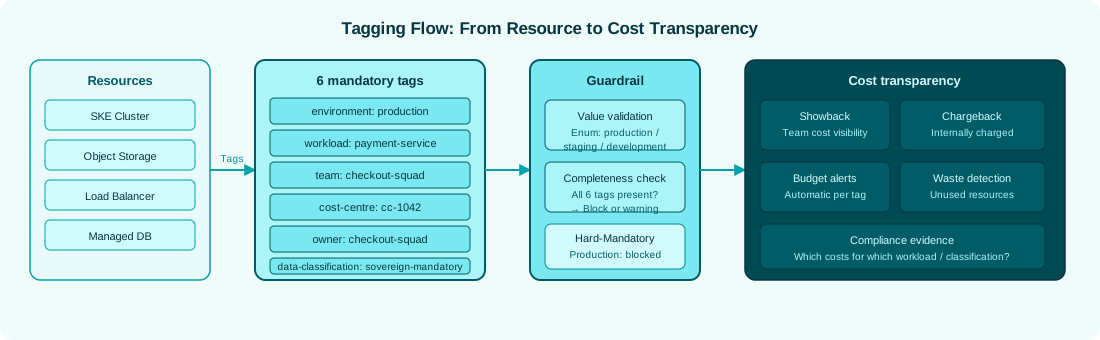
A tagging framework is more than a list of tag keys. It covers four dimensions that together determine whether the system works in practice.
What is tagged? Not every resource needs to carry every tag. The framework defines which resource types require which tags — distinguishing between core resources (VMs, storage, databases) and supporting resources (network configurations, security rules). This distinction prevents tag fatigue: teams aren’t asked to maintain 20 tags on a firewall rule.
What values are valid? Free-text values in tags are the beginning of the end. “dev”, “Dev”, “development”, “Development”, and “DEV” all mean the same thing — but from a cost-reporting and automation perspective they are four different values. A good framework defines allowed values for each tag wherever possible, making deviation visible.
Who is responsible? Each tag has an owner: someone who decides what the tag means, maintains the list of valid values, and handles exceptions. Without clear ownership, tags degrade silently — nobody notices when values become inconsistent, because nobody is watching.
How is compliance enforced? Enforcement has two dimensions: what happens when a non-compliant resource is created, and how existing non-compliance is identified and remediated. Both need a defined answer before the first guardrail is activated.
A tag schema that works is one that was designed collaboratively with the people who will apply it. Tags developed in isolation by a central team and then mandated to all teams tend to fail: either they don’t fit real-world needs, or teams don’t understand the purpose and apply them inconsistently.
Start with the questions you need to answer
The best tag schema is derived from the reporting and governance requirements it needs to serve. What cost allocation reports do we need? Who needs to prove compliance ownership? What does automated remediation need to identify? These questions determine the tags — not the other way around.
Involve the teams that will apply tags
Platform team, FinOps, security, and at least two application teams should be in the room. Teams that help design the schema understand its purpose and apply it consistently. Teams that receive a mandate from above apply it reluctantly — and inconsistently.
Define realistic, not ideal, valid values
Valid values should reflect how the organisation actually works — not how it ideally should work. A cost centre tag that requires a code that three teams don’t have yet will produce three non-compliant teams from day one. Work with Finance to ensure the valid values exist in the systems where they need to.
Document what each tag means
Every tag key needs a description: what does it mean, why is it needed, what are the valid values, who owns it? This documentation is the reference teams will consult when they’re unsure. Without it, tags are guesswork.
The most effective tag rollouts start small and expand based on evidence — not on a big-bang mandate that creates compliance theatre rather than real compliance.
The first phase is audit-only: monitoring without enforcement. New and existing resources are checked against the tag schema. Violations are visible but don’t block anything. This phase builds a picture of the current state and gives teams time to understand and apply the schema before it has consequences.
The second phase introduces soft enforcement for new resources: resources without mandatory tags trigger a notification. Teams are informed, given support to remediate, and given a timeline. The purpose is to stop new non-compliance from accumulating while existing non-compliance is being addressed.
The third phase reaches full enforcement: non-compliant new resources are blocked. Existing non-compliance has been remediated or explicitly acknowledged as an exception. The tag schema is now a real governance control, not an aspiration.
A tag catalogue defines which tags are mandatory for every cloud resource — and which values are permitted. Without defined value sets, tags become a free-text field that nobody can filter, report, or enforce automatically.
Five mandatory tags form the minimum standard for a governable cloud environment:
environment — The operational environment of the resource. Enables clear assignment of resources to lifecycle and operational phases.
| Value | Meaning |
|---|---|
prod | Production environment, used by end users or business processes |
dev | Development environment for new features and initial validation |
test | Test environment for functional, technical, or automated testing |
qa | Quality assurance before further release of a solution |
stage | Production-like validation before deployment to production |
uat | User Acceptance Testing by business users or stakeholders |
demo | Demonstration environment for customers, training, or internal demos |
archive | Archived or decommissioned resources still needed for audit or recovery |
int | Integration environment for interface and end-to-end testing |
sandbox | Experimentation and evaluation outside defined development processes |
provisioned-by — How the resource was created. This tag enables detection of resources created outside the IaC process — a critical governance signal.
| Value | Meaning |
|---|---|
iac | Provisioned through Infrastructure as Code (Terraform, OpenTofu, Pulumi, Bicep, CloudFormation) |
portal | Created through a web portal or graphical management interface |
cli | Provisioned through a Command Line Interface |
sdk | Provisioned through a cloud provider SDK |
rest-api | Provisioned directly through the cloud provider REST API |
Resources tagged portal or cli in a production environment signal that someone bypassed the IaC process — exactly the governance visibility this tag is designed to provide.
cost-center — The organisational unit bearing the costs. The value must be a valid identifier from the authoritative finance or ERP system. Only approved cost centre identifiers are permitted.
data-classification — The sensitivity of data processed, stored, or transmitted by the resource. Drives security controls, encryption requirements, and access restrictions.
| Value | Meaning |
|---|---|
public | Public or unclassified information, intended for publication |
internal | Internal information for employees, partners, or authorised third parties |
restricted | Increased protection requirements; unauthorised disclosure causes significant impact |
confidential | High protection requirements; unauthorised disclosure causes serious consequences |
secret | Very high protection requirements; disclosure causes critical consequences |
top-secret | Highest classification; disclosure causes existential or catastrophic consequences |
application-id — The unique identifier of the application from the CMDB or application register. This tag creates the traceable connection from cloud resource to business application.
Two governing principles apply to the entire tag catalogue: tags reference information, they do not duplicate it. A tag points to the authoritative system rather than reproducing its data inline. And tags never replace a CMDB — they reference it. The CMDB holds the full application context; the tag merely establishes the link.
What works
Few, meaningful tags with clear ownership. Valid values defined in advance. Enforcement introduced gradually. Teams involved in design. Exceptions handled through a defined process, not ad hoc overrides.
What fails
Too many tags that nobody understands. Free-text values that fragment reports. Big-bang enforcement that blocks teams before they understand the schema. Tags defined by the platform team alone without input from those who apply them.
Define reporting requirements: What questions should the tag schema answer? Cost by team, environment, project, data classification — these requirements drive the tag design, not abstract best practices.
Design the schema collaboratively: Workshop with platform team, FinOps, security, and representative application teams. Define tag keys, valid values, ownership, and the purpose of each tag.
Document and communicate: Every tag gets a description. The schema is published where all teams can find it. Teams that need to apply tags understand why — not just what.
Audit-only phase: Activate monitoring without enforcement. Understand the current state. Support teams in remediating existing non-compliance. Refine valid values based on what you learn.
Phased enforcement: Starting with the most critical resources, activate enforcement. Handle exceptions through a defined process. Expand to full coverage.
How the tag schema integrates into cost reporting and optimisation is covered in Showback & Chargeback.
Implement proactive budget alerts, cost visualization through showback, and internal cost allocation through chargeback.
Cloud cost management tools are widely available. Most organisations that struggle with cloud cost governance are not missing a tool — they are missing a rhythm. They have dashboards nobody looks at, alerts nobody acts on, and reports that arrive too late to influence the decisions that created the costs.
A governance rhythm is the regular cadence of review, decision, and action that turns cost data into steering intelligence. Without it, even the best tooling produces numbers that nobody acts on. With it, even simple tooling is enough to keep cloud costs predictable and under control.
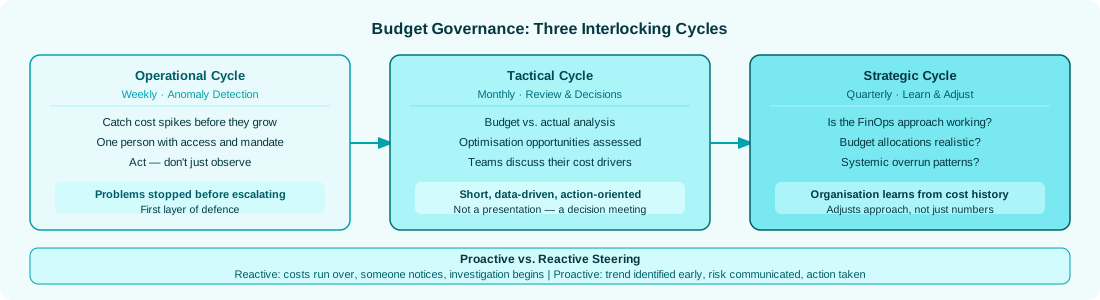
Budget governance works across three interlocking cycles, each with a different purpose and audience.
The operational cycle is the weekly layer. Its purpose is to catch anomalies before they become significant overruns. Someone reviews cost trends, checks for unusual spikes, and takes action where needed. This doesn’t require a committee or a formal meeting — it requires one person with the right access and the mandate to act. The operational cycle is where problems are stopped before they escalate.
The tactical cycle is the monthly layer. Its purpose is to review progress against budget, assess optimisation opportunities, and surface issues that the operational layer identified but couldn’t resolve. This is the meeting where teams discuss their cloud costs, where FinOps presents the month’s analysis, and where decisions about optimisation investments are made. Monthly reviews should be short, data-driven, and action-oriented — not a presentation of numbers for the sake of it.
The strategic cycle is the quarterly layer. Its purpose is to evaluate whether the FinOps approach itself is working. Are budget allocations realistic? Have organisational changes created mismatches between budget owners and actual spenders? Are there systemic patterns in the overruns that require structural changes? The quarterly review is where the organisation learns from its cost history and adjusts its approach.
An anomaly is a cost pattern that deviates meaningfully from what was expected. Detecting anomalies well requires a methodology — not just a threshold.
Baseline matters
An alert that fires every Monday because workloads scale up at the start of the week is noise. A useful anomaly detection system understands normal patterns — daily, weekly, and monthly — and only alerts when something deviates from those patterns. Building this baseline takes a few weeks of observation before anomaly detection becomes useful.
Context is everything
A cost spike is not automatically a problem. A planned migration, a product launch, or a one-time batch job can legitimately produce spikes. Good anomaly detection distinguishes between expected and unexpected deviations — which requires a channel where teams can flag planned events before they happen.
Fast investigation, not just alerting
An anomaly alert that triggers an investigation three days later is not useful for operational response. The alert needs to reach someone who can investigate quickly, and they need to have the access and skills to do so. Alert design and escalation path design go hand in hand.
Closure matters
Every anomaly should have a documented outcome: what was found, what caused it, what was done. This documentation builds an institutional memory that makes future anomalies faster to diagnose — and provides the evidence base for structural changes when patterns repeat.
The difference between a reactive and a proactive cloud cost organisation is not the tools they use — it’s the posture they take toward cost trends.
A reactive organisation responds to problems after they occur. Costs run over budget, someone notices, an investigation begins. By the time action is taken, the overrun is already significant.
A proactive organisation notices cost trends as they develop. It asks: if current consumption continues at this rate, where will we be at month end? Are there already resources being created that will materialise as costs in three days? This forward-looking posture requires an operational rhythm and the discipline to run it consistently — but it prevents a large category of budget overruns entirely.
Building this posture requires investment in three things: the right metrics (leading indicators, not just accumulated spend), the right people (someone whose job includes watching these metrics), and the right escalation path (so that when someone identifies a risk, they know what to do with it).
A budget governance system without a defined escalation path is incomplete. When an anomaly is found that the operational team cannot resolve, who is notified? When a team’s spend is on track to significantly exceed budget, who decides whether to intervene and how? When a cost reduction recommendation requires investment, who approves it?
These decisions should be made in advance, during calm — not under pressure when a problem has already escalated. The escalation path should be documented, communicated, and tested at least annually.
Establish baseline visibility: Before defining alert thresholds or review cadences, understand the organisation’s actual cost patterns. What does a normal week look like? What are the natural peaks and valleys? Two to four weeks of observation typically reveals enough to set meaningful baselines.
Design the operational cycle: Who reviews costs weekly, when, and using what data? This person needs clear access, a clear scope, and a clear mandate to act on what they find. The operational cycle only works if someone owns it.
Structure the monthly review: Define agenda, participants, and the outputs expected. The monthly review should produce decisions, not just discussion. What will we do about the optimisation opportunities identified? Who is responsible for following up?
Define the escalation path: What happens when the weekly review identifies a significant anomaly? What happens when a team is on track to significantly overspend? Document the decisions and the decision-makers before the situation arises.
Introduce the quarterly strategic review: Once the operational and tactical cycles are running, the quarterly review provides the space to evaluate whether the approach itself is working. Is the governance rhythm actually changing behaviour? Are costs becoming more predictable?
How budget governance connects to individual team responsibilities is described in the RACI model.
One of the most effective governance measures in cloud cost management is also one of the simplest in concept: cloud costs are allocated to the teams that incurred them — transparently, regularly, and in a traceable manner. This mechanism is called chargeback (internal billing) or showback (visibility without direct billing).
The core principle is clear: whoever consumes cloud resources should see those costs directly — or even be internally charged for them. Cost transparency creates incentives for economical behaviour. A development team that never sees its cloud bill has structurally little reason to work resource-efficiently. A team to which these costs are visible or directly allocated develops a different cost awareness.
Showback is the pragmatic entry point. Each team receives a regular breakdown of its cloud costs — segmented by workloads, environments, and services. This breakdown is informative, not binding: no budget is directly charged. Showback creates awareness and is the ideal starting point before full chargeback mechanisms are established.
The prerequisite for functioning showback is complete tagging of all cloud resources. Without correct tags, costs cannot be allocated to the right teams — that is the most common reason why showback reports are incomplete or incorrect.
Chargeback goes a step further: cloud costs are internally billed. Teams receive a cloud budget against which their actual consumption is offset. Overruns become visible and must be justified. Underspend can be returned or planned for future periods.
Chargeback only works when the prerequisites are right: complete cost allocation through tags, an accepted method for cost allocation (how are shared services distributed across teams?), and an agreed governance process for budget overruns. Cost allocation based on actual consumption creates incentives for economical cloud usage — that is the real value. Cost awareness doesn’t emerge from dashboard subscriptions, but from costs becoming part of team responsibility.
Hold a formal milestone meeting where the CIO, CTO, CFO, and CISO sign off on the readiness scorecard, release budgets, and provide signatures.
The approval meeting is not a status update. It is the founding event of the Adoption phase — the moment when the organisation collectively decides: “We are ready. We are committing. We are starting.”
Without this formal event, the Adoption phase lacks:
Duration: 2–3 hours
Location: Physical meeting recommended (not a virtual checkbox exercise)
| Time block | Agenda item | Who |
|---|---|---|
| 15 min | Welcome and purpose of the meeting | CIO |
| 30 min | Readiness scorecard: results of all 5 dimensions | CCoE Lead |
| 20 min | Open items and risk assessment | CCoE Lead |
| 20 min | Adoption roadmap: first migration waves, resource plan | CCoE Lead |
| 15 min | Questions and discussion | All |
| 15 min | Formal approval: signatures | Cloud Strategy Board |
| 5 min | Communication kick-off | CIO |
Signatories (mandatory):
Advisory attendance:
The approval document is the binding output of the meeting:
Date: [Date]
Organisation: [Name]
The following is hereby confirmed:
The Advisory phase of the cloud transformation has been completed successfully. All defined deliverables (Cloud Strategy, Business Case, CCoE establishment, FinOps framework, change management programme, governance framework, readiness assessment) are in place.
The 5-dimension readiness assessment has been conducted. All dimensions have reached the “Ready” criterion or will do so by [Date] (open items: [list]).
The annual cloud budget for the Adoption phase in the amount of [TEUR X] is approved.
The Adoption roadmap with the following first migration waves is approved:
The CCoE is fully staffed with [N] FTE and operational.
Escalation paths and governance:
| Role | Name | Signature | Date |
|---|---|---|---|
| CIO | |||
| CTO | |||
| CFO | |||
| CISO |
A digital approval by email is not the same as a personal signature in a shared meeting. Signatures create:
Commitment: Every signatory has publicly committed. This makes it harder to distance oneself from the transformation later.
Simultaneity: All four C-level functions commit together — no later claim that “this was just an IT project”.
Documented budget commitment: The CFO has approved the budget in the document — no later “this wasn’t in the budget plan”.
Historical reference: In later governance conflicts, there is a document that shows: this decision was made consciously and collectively.
The CIO communicates the start of the Adoption phase to the organisation within 24 hours: