Cloud cost management tools are widely available. Most organisations that struggle with cloud cost governance are not missing a tool — they are missing a rhythm. They have dashboards nobody looks at, alerts nobody acts on, and reports that arrive too late to influence the decisions that created the costs.
A governance rhythm is the regular cadence of review, decision, and action that turns cost data into steering intelligence. Without it, even the best tooling produces numbers that nobody acts on. With it, even simple tooling is enough to keep cloud costs predictable and under control.
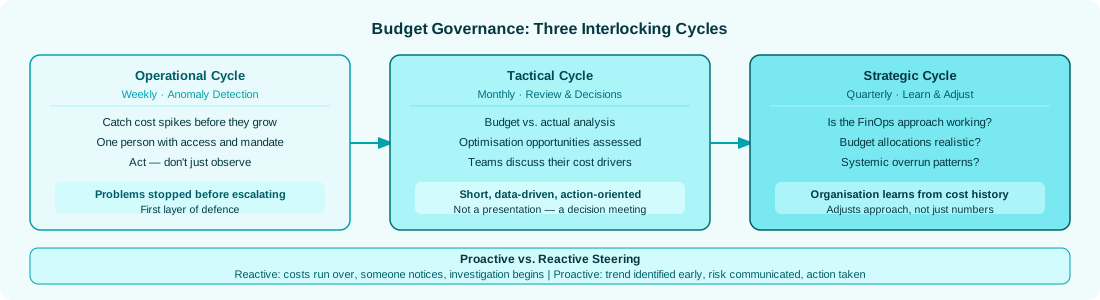
Budget governance works across three interlocking cycles, each with a different purpose and audience.
The operational cycle is the weekly layer. Its purpose is to catch anomalies before they become significant overruns. Someone reviews cost trends, checks for unusual spikes, and takes action where needed. This doesn’t require a committee or a formal meeting — it requires one person with the right access and the mandate to act. The operational cycle is where problems are stopped before they escalate.
The tactical cycle is the monthly layer. Its purpose is to review progress against budget, assess optimisation opportunities, and surface issues that the operational layer identified but couldn’t resolve. This is the meeting where teams discuss their cloud costs, where FinOps presents the month’s analysis, and where decisions about optimisation investments are made. Monthly reviews should be short, data-driven, and action-oriented — not a presentation of numbers for the sake of it.
The strategic cycle is the quarterly layer. Its purpose is to evaluate whether the FinOps approach itself is working. Are budget allocations realistic? Have organisational changes created mismatches between budget owners and actual spenders? Are there systemic patterns in the overruns that require structural changes? The quarterly review is where the organisation learns from its cost history and adjusts its approach.
An anomaly is a cost pattern that deviates meaningfully from what was expected. Detecting anomalies well requires a methodology — not just a threshold.
Baseline matters
An alert that fires every Monday because workloads scale up at the start of the week is noise. A
useful anomaly detection system understands normal patterns — daily, weekly, and monthly — and
only alerts when something deviates from those patterns. Building this baseline takes a few
weeks of observation before anomaly detection becomes useful.
Context is everything
A cost spike is not automatically a problem. A planned migration, a product launch, or a
one-time batch job can legitimately produce spikes. Good anomaly detection distinguishes between
expected and unexpected deviations — which requires a channel where teams can flag planned
events before they happen.
Fast investigation, not just alerting
An anomaly alert that triggers an investigation three days later is not useful for operational
response. The alert needs to reach someone who can investigate quickly, and they need to have
the access and skills to do so. Alert design and escalation path design go hand in hand.
Closure matters
Every anomaly should have a documented outcome: what was found, what caused it, what was done.
This documentation builds an institutional memory that makes future anomalies faster to diagnose
— and provides the evidence base for structural changes when patterns repeat.
The difference between a reactive and a proactive cloud cost organisation is not the tools they use — it’s the posture they take toward cost trends.
A reactive organisation responds to problems after they occur. Costs run over budget, someone notices, an investigation begins. By the time action is taken, the overrun is already significant.
A proactive organisation notices cost trends as they develop. It asks: if current consumption continues at this rate, where will we be at month end? Are there already resources being created that will materialise as costs in three days? This forward-looking posture requires an operational rhythm and the discipline to run it consistently — but it prevents a large category of budget overruns entirely.
Building this posture requires investment in three things: the right metrics (leading indicators, not just accumulated spend), the right people (someone whose job includes watching these metrics), and the right escalation path (so that when someone identifies a risk, they know what to do with it).
A budget governance system without a defined escalation path is incomplete. When an anomaly is found that the operational team cannot resolve, who is notified? When a team’s spend is on track to significantly exceed budget, who decides whether to intervene and how? When a cost reduction recommendation requires investment, who approves it?
These decisions should be made in advance, during calm — not under pressure when a problem has already escalated. The escalation path should be documented, communicated, and tested at least annually.
Establish baseline visibility: Before defining alert thresholds or review cadences, understand the organisation’s actual cost patterns. What does a normal week look like? What are the natural peaks and valleys? Two to four weeks of observation typically reveals enough to set meaningful baselines.
Design the operational cycle: Who reviews costs weekly, when, and using what data? This person needs clear access, a clear scope, and a clear mandate to act on what they find. The operational cycle only works if someone owns it.
Structure the monthly review: Define agenda, participants, and the outputs expected. The monthly review should produce decisions, not just discussion. What will we do about the optimisation opportunities identified? Who is responsible for following up?
Define the escalation path: What happens when the weekly review identifies a significant anomaly? What happens when a team is on track to significantly overspend? Document the decisions and the decision-makers before the situation arises.
Introduce the quarterly strategic review: Once the operational and tactical cycles are running, the quarterly review provides the space to evaluate whether the approach itself is working. Is the governance rhythm actually changing behaviour? Are costs becoming more predictable?
How budget governance connects to individual team responsibilities is described in the RACI model.
Chargeback and Showback: Cost Transparency as a Governance Instrument
One of the most effective governance measures in cloud cost management is also one of the simplest in concept: cloud costs are allocated to the teams that incurred them — transparently, regularly, and in a traceable manner. This mechanism is called chargeback (internal billing) or showback (visibility without direct billing).
The core principle is clear: whoever consumes cloud resources should see those costs directly — or even be internally charged for them. Cost transparency creates incentives for economical behaviour. A development team that never sees its cloud bill has structurally little reason to work resource-efficiently. A team to which these costs are visible or directly allocated develops a different cost awareness.
Showback is the pragmatic entry point. Each team receives a regular breakdown of its cloud costs — segmented by workloads, environments, and services. This breakdown is informative, not binding: no budget is directly charged. Showback creates awareness and is the ideal starting point before full chargeback mechanisms are established.
The prerequisite for functioning showback is complete tagging of all cloud resources. Without correct tags, costs cannot be allocated to the right teams — that is the most common reason why showback reports are incomplete or incorrect.
Chargeback goes a step further: cloud costs are internally billed. Teams receive a cloud budget against which their actual consumption is offset. Overruns become visible and must be justified. Underspend can be returned or planned for future periods.
Chargeback only works when the prerequisites are right: complete cost allocation through tags, an accepted method for cost allocation (how are shared services distributed across teams?), and an agreed governance process for budget overruns. Cost allocation based on actual consumption creates incentives for economical cloud usage — that is the real value. Cost awareness doesn’t emerge from dashboard subscriptions, but from costs becoming part of team responsibility.
External link
You are leaving the trail
This link goes to an external site outside STACKIT. We do not vet third-party content or downloads, so follow it only if you trust the source.