Three-Pillar Model
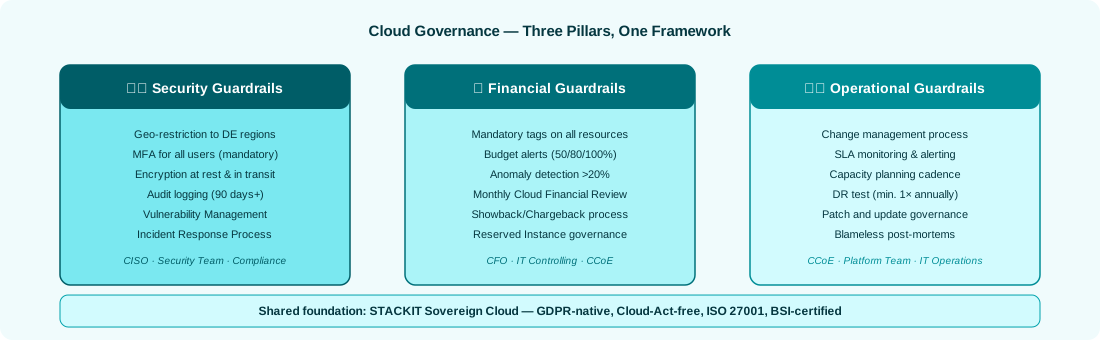
Security guardrails, financial guardrails and operational guardrails — the three dimensions that together produce a complete governance structure.
Governance is not the enemy of agility. It is the prerequisite for agility being possible at all in regulated environments.
Cloud governance solves a fundamental tension: development teams want to act quickly and independently. Compliance, security and financial controlling want control and traceability. In the cloud, both requirements can be met simultaneously — if governance is designed from the start as an enabler, not as an approval authority.
This chapter shows you how to build cloud governance that automatically fulfils regulatory requirements from GDPR to BSI IT-Grundschutz, without slowing down teams, and provides auditors with the evidence they need.
Three-Pillar Model
Security guardrails, financial guardrails and operational guardrails — the three dimensions that together produce a complete governance structure.
Automate Compliance
How GDPR, TISAX, BAIT, DORA, KHZG, BSI IT-Grundschutz, ISO 27001, NIS2 and KRITIS requirements are translated into automated verification processes.
Distribute Responsibility Clearly
The shared responsibility matrix between STACKIT and your organisation — precisely defined, documented and demonstrable for audits.
Handle Exceptions Structurally
How to manage the inevitable exceptions to governance rules so that they are approved, time-limited and fully logged.
A public authority with 600 IT employees introduced cloud services without establishing a governance structure. After 18 months, the BSI audit found 23 critical findings: missing access controls, unencrypted data storage, no audit logs, undocumented processing activities. Restoring compliance cost EUR 180,000 and six months of standstill.
The lesson: introducing governance after the fact costs three times as much — and generates far more friction than establishing it from the start.
For regulated industries, robust cloud governance is not a cost factor — it is a strategic advantage. Organisations that can demonstrate their cloud environment is GDPR-compliant, BSI-certified and auditable win contracts that others cannot accept for compliance reasons.
STACKIT as a sovereign cloud without US Cloud Act exposure is the technical foundation. Governance is the organisational structure that turns this advantage into demonstrable compliance.
Governance defines the framework within which the CCoE operates. The Cloud Strategy sets the regulatory requirements — Governance translates them into operative controls. The Transition to Adoption assesses governance readiness as a go-live criterion.