Why sovereignty is a strategy, not a feature
Section titled “Why sovereignty is a strategy, not a feature”Many organisations treat data sovereignty as a compliance checkbox. That is a mistake. Sovereignty is a strategic decision with profound consequences for provider selection, IT architecture, contract design and competitive positioning.
The core question is not: “Are we GDPR-compliant?” The core question is: “Who has access to our data in an emergency — and can we control that?”
The CLOUD Act: A concrete risk for Regulated Industries
Section titled “The CLOUD Act: A concrete risk for Regulated Industries”The US CLOUD Act (Clarifying Lawful Overseas Use of Data Act, 2018) empowers US authorities to demand access to data from US companies — regardless of where that data is physically stored.
The Reality: Even if your data sits in a data centre in Frankfurt, a US provider may be legally obliged to hand that data to US authorities.
For organisations in highly regulated sectors this is not a theoretical risk but a concrete compliance and operational bottleneck:
- Automotive: TISAX requirements
- Banking & Finance: BAIT / DORA compliance
- Healthcare: KHZG regulations
- Critical Infrastructure: KRITIS / NIS-2 directives
STACKIT: The Sovereign Cloud Alternative
Section titled “STACKIT: The Sovereign Cloud Alternative”STACKIT (the digital brand of Schwarz Digits, the IT powerhouse of the Schwarz Group) offers a distinct alternative to non-European hyperscalers. It is designed to completely eliminate third-country access risks.
Key Sovereignty Characteristics
Section titled “Key Sovereignty Characteristics”| Characteristic | Significance |
|---|---|
| German company | No US Cloud Act risk — no obligation to disclose to US authorities |
| Data centres in Germany & Austria | GDPR-native data residency, Art. 44 GDPR not a concern |
| Open standards | Built on OpenStack, Kubernetes, Terraform — zero proprietary vendor lock-in |
| Contractual guarantees | DPA per GDPR Art. 28, transparent data processing agreements, and a dedicated Data Protection Cockpit |
| BSI C5 attestation | Demonstrated high-level security controls under the premier German standard |
The Four Pillars of STACKIT Sovereignty
Section titled “The Four Pillars of STACKIT Sovereignty”- Legal Sovereignty: Data is stored and processed exclusively under European jurisdiction, shielded from extraterritorial laws.
- Technological Freedom: Open-source architectures ensure maximum transparency, code auditability, and effortless interoperability.
- Organizational Independence: Migration patterns and exit strategies are designed so you always retain absolute control over your operational data.
- Economic Stability: Backed by the financial strength of the Schwarz Group, ensuring long-term operational viability free from volatile market shifts.
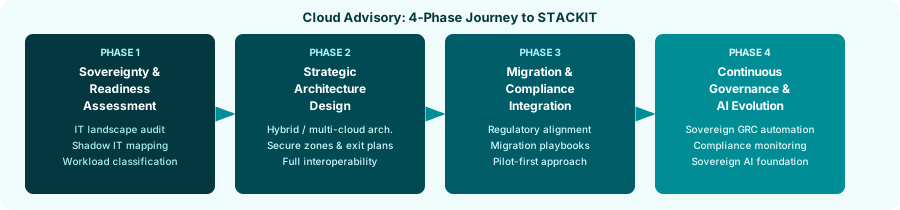
Our 4-Phase Cloud Advisory Journey
Section titled “Our 4-Phase Cloud Advisory Journey”Transitioning to a sovereign cloud requires a structured roadmap. We guide your organization from initial assessment to fully compliant, continuous operations on STACKIT.
Phase 1: Sovereignty & Readiness Assessment
Section titled “Phase 1: Sovereignty & Readiness Assessment”We audit your current IT landscape to identify third-party dependencies, map shadow IT, and classify your existing workloads based on regulatory and organizational needs.
Phase 2: Strategic Architecture Design
Section titled “Phase 2: Strategic Architecture Design”We design hybrid or multi-cloud target architectures using open-source standards. This includes setting up secure zones, planning exit strategies, and ensuring complete interoperability.
Phase 3: Migration & Compliance Integration
Section titled “Phase 3: Migration & Compliance Integration”We align STACKIT’s native security controls with your specific regulatory frameworks (BSI IT-Grundschutz, ISO 27001, GDPR). We then execute migration playbooks, beginning with low-risk pilots before moving core systems.
Phase 4: Continuous Governance & AI Evolution
Section titled “Phase 4: Continuous Governance & AI Evolution”We establish sovereign GRC (Governance, Risk, Compliance) automation and lay the groundwork for adopting secure, sovereign AI models hosted entirely within STACKIT’s secure infrastructure.
Our Methodology: Three-Tier Workload Classification
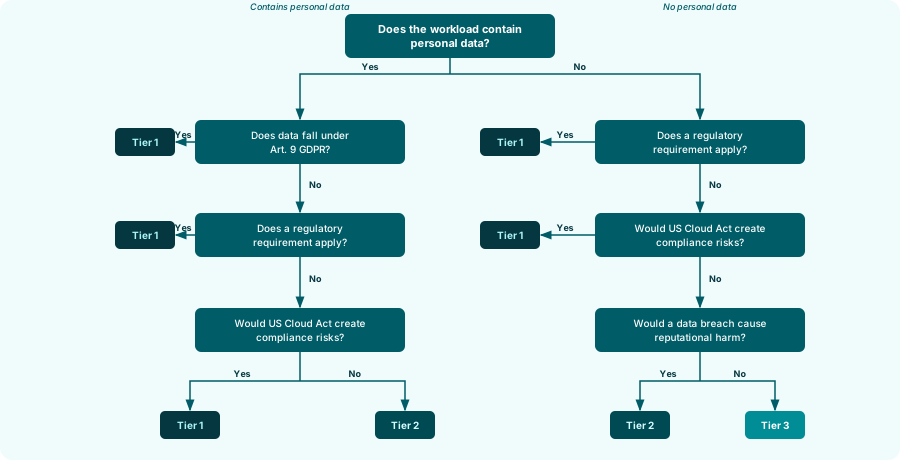
Section titled “Our Methodology: Three-Tier Workload Classification”Not all workloads have the same sovereignty requirements. To avoid over-engineering or unnecessary costs, we classify your applications into three distinct tiers:
Tier 1: Sovereignty-mandatory
Section titled “Tier 1: Sovereignty-mandatory”Criteria: Regulatory or contractual obligation for local data storage and processing; data that creates severe liability risks if accessed by foreign authorities; sensitive personal data (Art. 9 GDPR).
Examples: Core customer data, health records, financial transactions, TISAX-classified development files, and KRITIS control systems.
Requirement: Exclusively STACKIT (or equivalent sovereign cloud). No deployment on US hyperscalers.
Tier 2: Sovereignty-preferred
Section titled “Tier 2: Sovereignty-preferred”Criteria: No hard regulatory veto, but elevated protection needs. Data that would cause reputational damage or competitive disadvantage if compromised.
Examples: ERP systems, HR databases (without special categories of personal data), internal communication platforms, and proprietary product designs.
Requirement: STACKIT preferred; other secure European providers acceptable. US hyperscalers are not recommended.
Tier 3: Flexible
Section titled “Tier 3: Flexible”Criteria: No personal data, non-sensitive operational data, or public-facing assets where speed and global reach outweigh strict sovereignty.
Examples: Public websites, CDN content, open-source build artifacts, and isolated development sandboxes.
Requirement: Any cloud provider is acceptable.
The Sovereignty Decision Tree
Section titled “The Sovereignty Decision Tree”To determine where your workloads belong, we guide you through five core questions:
Practical steps
Section titled “Practical steps”Securing your digital sovereignty is an active process. We work alongside your teams to execute these immediate, practical steps:
- Step 1: Create workload inventory — Build a comprehensive directory of all applications and their respective data categories
- Step 2: Sovereignty workshop — Bring together CISO, DPO and legal department to complete the three-tier classification
- Step 3: Establish the sovereignty matrix — Set up a living, audited document that assigns clear ownership and hosting rules for every workload
- Step 4: Appoint a Data Sovereignty Officer — Define clear accountability and sovereignty governance for cloud operations
- Step 5: Contractual safeguarding — Finalize DPAs with STACKIT, configure the Data Protection Cockpit to match your security baseline.