Strategic North Star
Formulate a cloud vision that orients investment decisions, architecture directions and cultural change for the next five to ten years.
Those who begin cloud transformation without a strategy buy new costs — those who begin with a strategy buy future capability. Here you establish the difference.
Cloud transformation rarely fails because of technology. It fails because of missing strategic clarity: why are we transforming? What do we want to be able to do in five years that we cannot do today? Which workloads must absolutely be run with full sovereignty?
This chapter gives you the tools to answer these questions binding with your board, your CIO staff and your business units — before the first technical decision is made.
Strategic North Star
Formulate a cloud vision that orients investment decisions, architecture directions and cultural change for the next five to ten years.
Sovereignty Profile
Understand which of your workloads fall under German data protection law, require Cloud Act immunity or must fulfil industry-specific regulations.
Well-Founded Provider Selection
Make the decision between STACKIT and US Hyperscalers based on a transparent, traceable evaluation matrix — not based on marketing.
Governance Structure
Establish the Cloud Strategy Board as a decision-making body that protects and develops the cloud vision across organisational boundaries.
Moving infrastructure to the cloud is migration. Understanding how your organisation becomes faster, more resilient and more competitive through it — that is transformation. Only transformation generates lasting business value.
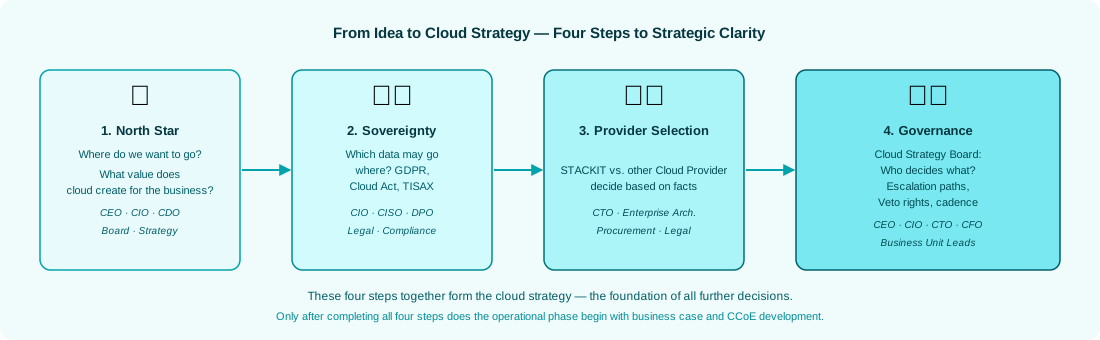
This chapter establishes the strategic framework. The operational implementation — discovery, workload assessment, migration waves — is described in the STACKIT Migration Framework. Advisory comes first: without an adopted cloud vision the Migration Framework lacks its mandate.