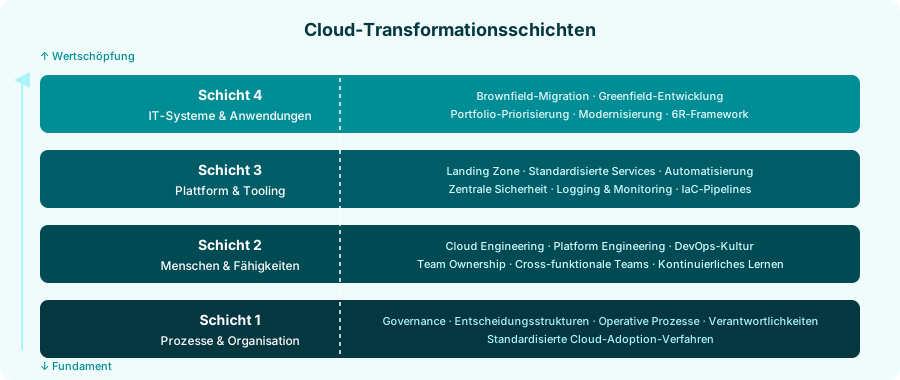
Cloud transformation is not an infrastructure project. It is a strategic change across four closely interconnected dimensions: organisational structures and processes must adapt, people need new skills and ways of working, platforms and tools must be built, and the IT application portfolio must be actively developed. These four layers interlock — a transformation that addresses only one layer achieves no lasting change.
The most common mistake is treating cloud transformation as a purely technical undertaking: procure new infrastructure, migrate applications, done. The typical result is a more expensive, more complex IT landscape — with the same organisational dysfunctions, just in new packaging. Transformation only succeeds when all four layers are addressed simultaneously and in a coordinated way.
Cloud technologies require adapted organisational structures and processes. This is not a matter of preference — new technologies don’t work effectively in old structures. A cloud-native operating model requires that decisions are made more decentrally, responsibility is clearly assigned, and standard processes for cloud adoption are in place.
The essential changes concern decision-making and governance structures. Who can provision which cloud resources? How are architecture questions escalated? Which teams have independent decision-making authority, and which decisions require central approval? These questions must be answered before the first production application goes to the cloud — not afterwards.
Operational and security processes must be redesigned for cloud reality: deployment processes, incident management, change control, and capacity planning have different requirements in cloud environments than in on-premises infrastructure. Not adapting these processes means operating cloud infrastructure with an on-premises mindset — with the corresponding friction losses.
Clear assignment of responsibilities is the central governance lever. Cloud operations without clear ownership creates gaps in security, cost control, and compliance. The RACI model of the cloud operating model defines these responsibilities in a binding way.
Governance Structures
Definition of decision rights, escalation paths, and approval processes for cloud resources. The
CCoE is the central governance body — it sets standards and monitors compliance, without taking
on operational tasks of platform teams.
Operational Processes
Adaptation of deployment, incident, and change processes for cloud environments. Automation
replaces manual processes wherever they endanger scalability or consistency.
Responsibilities
Standardised procedures for cloud architecture decisions and clear ownership assignment for all
cloud resources. No workload without a named responsible owner.
Cloud technologies require new skills and new ways of working. This is the most critical and most frequently underestimated transformation layer. Technology can be purchased — capabilities must be built. And capability development takes time, investment, and patience.
The central competency areas are cloud engineering, platform engineering, and DevOps. Cloud engineers understand the principles and services of cloud platforms and can design workloads to meet requirements. Platform engineers build and operate the internal platform on which application teams develop. DevOps practices bridge the traditional separation between development and operations and enable shorter delivery cycles.
A particularly important cultural shift is increasing team ownership. In cloud-native organisations, development teams carry responsibility for the entire lifecycle of their applications — from development through deployment to operations. This “you build it, you run it” culture requires new skills but also organisational trust and corresponding autonomy.
Cross-functional teams are the organisational vehicle for this transformation. When development, operations, security, and architecture work in shared teams, faster decisions, better solutions, and fewer friction losses at interfaces emerge.
Investment in people is not a soft measure — it is the prerequisite for all other transformation layers to become effective. An organisation that purchases cloud infrastructure without investing in cloud capabilities is buying complexity without enablement.
The platform layer is the technological foundation of the transformation. It consists of the cloud platform architecture (Landing Zone), standardised infrastructure and platform services, automation capabilities, and central services for security, logging, and monitoring.
The Landing Zone is not a single server or a simple network segment — it is the totality of all pre-configured, governance-compliant cloud environments into which workloads are deployed. A well-designed Landing Zone makes compliance the default: teams land in an environment that is already correctly configured, rather than an empty canvas where everything must be set up manually.
Standardised services reduce duplication and increase quality. If every application team must invent its own logging, identity management, and network segmentation, a fragmented landscape with inconsistent security levels emerges. Central platform services solve this problem: teams consume ready-made building blocks and focus on application logic.
Automation is the operational principle of the platform layer. Infrastructure provisioning, deployment pipelines, security scans, and compliance checks run automatically — not because automation is an end in itself, but because manual processes cannot keep pace with the speed and scalability of cloud environments.
The fourth transformation layer encompasses the entire application portfolio of the organisation. It is addressed through two fundamentally different approaches that are often pursued in parallel and with different teams.
Migration of existing systems (Brownfield) refers to moving existing applications to the cloud. There is no universal recipe: the migration pattern depends on the application’s architecture, its dependencies, operational effort, and business value. A structured portfolio assessment — often called the “6R framework” (Rehost, Replatform, Refactor, Repurchase, Retire, Retain) — helps determine the right approach for each application.
Development of new applications (Greenfield) offers the opportunity to build cloud-native from the start. Here all cloud advantages can be leveraged: managed services, automated deployment, horizontal scalability, Infrastructure as Code. Greenfield projects are simultaneously the best learning laboratories for the organisation — teams build capabilities that can later be used in the modernisation of brownfield applications.
Portfolio prioritisation is a strategic decision: which applications are migrated or modernised first? Typically these are applications with high operational burden, expiring support, or high potential for cloud-native optimisation — not necessarily the most critical production systems.
Establish governance first: Before workloads are deployed, decision structures, responsibilities, and core processes must be defined. Introducing governance retrospectively is many times more expensive.
Build platform and skills in parallel: The Landing Zone and the first cloud competencies are developed together — teams learn on the real platform, and the platform is improved through real user experiences.
Start with greenfield projects: New applications on the cloud platform give the organisation real experience with cloud-native patterns before complex migrations are tackled.
Address brownfield systematically: The application portfolio is prioritised by clear criteria and migrated step by step — with pre-defined success measures and exit criteria for each phase.
The four transformation layers are not a sequential checklist — they are addressed iteratively and in parallel. What changes is the intensity: in early phases, governance and platform building dominate. In later phases, capability expansion and portfolio migration dominate.
External link
You are leaving the trail
This link goes to an external site outside STACKIT. We do not vet third-party content or downloads, so follow it only if you trust the source.