Making costs visible
A consistent tagging strategy with six mandatory tags turns an anonymous cloud invoice pile into a readable cost allocation per team, project and business unit.
Cloud costs grow until someone takes responsibility. This chapter shows how to structure that responsibility — without constraining team agility.
Cloud costs behave fundamentally differently from on-premises costs: they arise dynamically, by the minute, through decisions made by dozens of teams — and they are visible the moment a resource is started. That is an opportunity for transparency. And it is a risk when nobody structures that transparency.
This chapter guides you through the FinOps principle: the collaboration of finance, technology and business to understand, govern and optimise cloud costs together. Not as a cost reduction programme, but as a permanent management capability.
Making costs visible
A consistent tagging strategy with six mandatory tags turns an anonymous cloud invoice pile into a readable cost allocation per team, project and business unit.
Distributing accountability
Showback and chargeback as a mechanism that motivates cost-conscious behaviour in teams — without a central control apparatus that constrains agility.
Proactive budget management
Anomaly detection, monthly Cloud Financial Reviews and a clear escalation path for budget overruns — before the CFO asks the question.
Building FinOps maturity
The path from Crawl to Walk to Run: which capabilities to build in which sequence — and what realistic optimisation targets are at each maturity stage.
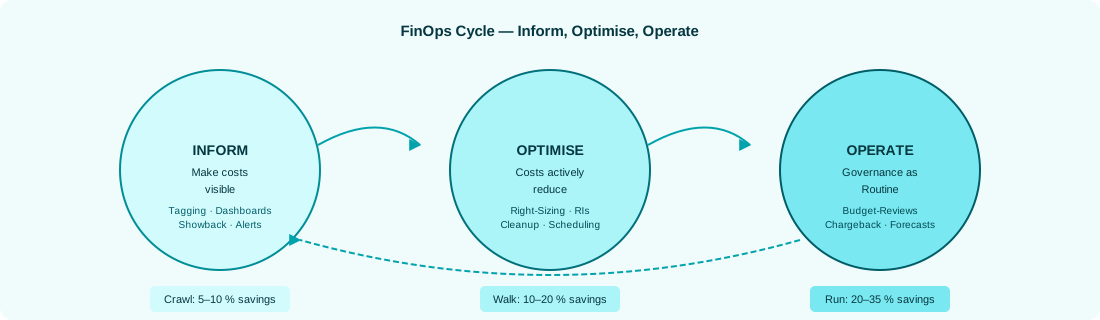
A media company with 200 IT employees accumulated EUR 72,000 per month in cloud waste over six months — unused VMs, unterminated test environments, oversized database instances. Nobody saw it because no tagging strategy existed and no department recognised the costs as their own.
The cause was not carelessness. It was missing structure: no cost allocation, no alerts, no regular review.
FinOps is not cost reduction. It is cost awareness as an organisational capability.
Cloud finance management only works when three groups collaborate that in classic IT organisations rarely speak with one another.
Finance & Controlling bring budget discipline, forecasting methodology and the CFO perspective. They learn to understand cloud costs as a variable, controllable model — not as fixed infrastructure expenditure.
Technology teams (CCoE, Platform Engineering) bring the expertise to reduce costs technically: right-sizing, reserved instances, automated cleanup. They learn to extend their decisions with a cost perspective.
Business units bring the demand and the priorities. They learn that cloud resources are not a free good — and that through responsible behaviour they directly influence their unit’s IT costs.
Cloud Finance Management is the operative financial steering that the Business Case defines as a strategic goal. The CCoE is responsible for the technical implementation of the tagging strategy and anomaly detection.