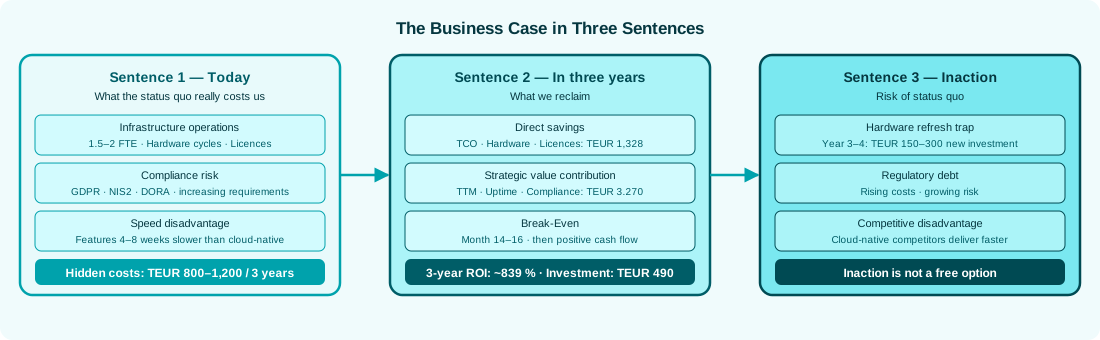
A CFO does not read four pages of detail. They need a story: today the status quo costs us X — in three years we will have recovered Y — and the risk of inaction is Z.
Transformation projects are not approved through detailed calculations. They are approved through narratives — condensed stories that decision-makers can understand in three minutes. The detailed analysis provides the credibility. The story provides the decision.
The business case for cloud transformation with STACKIT consists of three sentences — all three must hold for the decision to stand.
Sentence 1: What the status quo actually costs today
The status quo feels cheap because its costs are invisible. The server costs appear on the balance sheet. What does not appear: the hardware refresh cycle that inevitably arrives in year 3 or 4; the VMware licences that became significantly more expensive after the Broadcom acquisition; the 1.5 to 2 full-time equivalents who manage infrastructure operations instead of building new products; and the downtime costs that every hour of unplanned outage generates.
For a mid-size organisation with 100–150 servers, these invisible costs add up to EUR 800,000 to 1.2 million over three years — without spending a single euro on cloud. That is the starting point of the calculation, not the cloud budget.
Add the compliance risk: GDPR, NIS2, DORA and sector-specific regulation generate documentation obligations that are increasingly expensive to satisfy with classical on-premises infrastructure. Every audit that finds gaps costs — in direct remediation, in reputational risk, in potential fines.
The direct savings — TCO delta, avoided hardware refresh, licence costs — are conservatively calculable. How significant they are depends on your specific starting position: how old is your hardware? Which licence renewals are pending? What are your current operating costs? You know these numbers — and they are the foundation of the business case, not external benchmarks. Calculate with your own figures. The full methodology is under TCO Analysis and ROI & Payback.
Doing nothing is not a cost-free option. It is a decision with its own price tag.
The hardware refresh trap
In year 3 or 4, the next on-premises infrastructure investment cycle arrives — typically EUR
150,000 to 300,000. Organisations that do not transform now pay this price and then transform
anyway — with outdated infrastructure as ballast.
Regulatory backlog
NIS2, DORA and tightened GDPR interpretations raise requirements each year. Organisations that
do not transform pay increasing compliance costs for an infrastructure that finds those
requirements ever harder to meet.
Talent problem
Qualified IT professionals want to work in modern environments. Organisations that do not build
cloud competence lose talent to competitors that do — and pay higher salaries for on-premises
specialists who are becoming scarcer.
Competitive disadvantage
Competitors developing cloud-natively ship features faster, respond more flexibly to market
changes, and scale at lower cost. The lead they have today of 12 months will be harder to close
in three years.
The Cloud Act applies to US Hyperscalers: US authorities can theoretically demand access to data held on US servers or managed by US companies — regardless of the physical location of the servers. STACKIT is a German company with German data centres. This difference is not a marketing argument but a legal fact that is immediately relevant for GDPR compliance, TISAX certification, BAIT-compliant outsourcing, and any other regulated industry.
The sovereign cloud advantage has a quantifiable value: lower audit effort, simpler Data Processing Agreement design, lower risk of regulatory remediation. The full analysis is under Sovereignty Premium.
The three sentences — for your next board presentation
Status quo: Our on-premises infrastructure costs us approximately X euros in direct and indirect costs over three years — without accounting for growing compliance risks.
Transformation: A cloud transformation on STACKIT returns [your TCO delta + strategic value contributions] over three years — with simultaneously higher security, compliance stability, and development velocity.
Risk of inaction: If we do not transform, we invest again in on-premises hardware in year 3, pay increasing licence and compliance costs, and fall further behind competitors who made the move.