Many organisations reach a point where they know their total cloud bill, but cannot say which team, product, or project is responsible for what share. When costs rise, nobody knows where to look. When cost reduction is needed, nobody can make informed decisions about where to cut.
The answer seems obvious: charge teams for what they consume. But organisations that jump directly from consolidated billing to chargeback — before teams have visibility into their own consumption, before the data is trustworthy, before the cultural groundwork is laid — create conflict rather than accountability.
Showback is the necessary first step. It makes costs visible to the teams that create them, without financial consequences. It builds the data quality and cultural familiarity that make chargeback work.
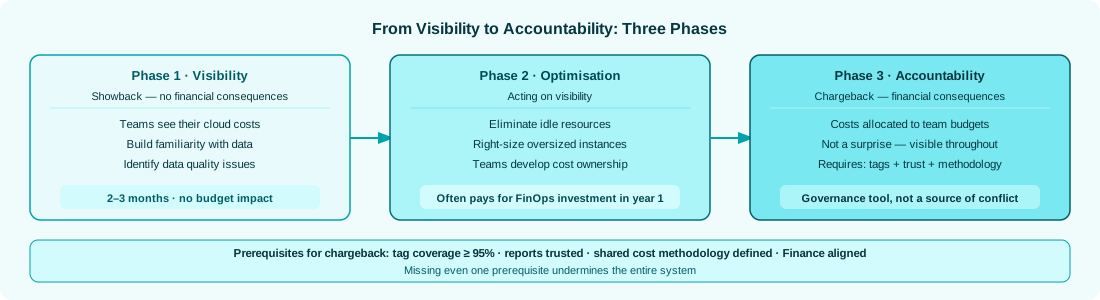
Teams receive regular reports showing their cloud costs — broken down by resource type,
environment, and project. No financial consequences. The goal is familiarity: teams learn to
read the reports, understand what drives their costs, and identify anomalies. This phase
typically runs for two to three months.
Phase 2: Optimisation
Armed with visibility, teams identify and eliminate waste: idle resources, oversized instances,
unused storage. This phase often generates significant cost savings on its own — and critically,
teams develop ownership of their costs before those costs are charged back to their budget.
Phase 3: Accountability
With clean data, an established reporting rhythm, and teams that understand their cost drivers,
chargeback becomes a governance tool rather than a source of conflict. Costs are allocated to
the budgets that created them. The financial consequences are not a surprise — they were visible
throughout.
Chargeback should not be introduced before several prerequisites are in place. Missing even one of them tends to undermine the entire system.
Tagging coverage is complete. If 30% of resources are untagged, 30% of costs cannot be allocated. These unallocated costs become a source of ongoing dispute — or they accumulate in a shared bucket that nobody owns. Tagging must be at or near 100% for chargeback to be credible.
Cost reports are trusted. Teams need to believe that the numbers are accurate before they accept financial consequences based on them. The showback phase builds this trust by giving teams time to identify and report data quality issues — and seeing those issues addressed.
An exception process exists for shared costs. Not all costs can be cleanly attributed to a single team: shared platform costs, central security tooling, common networking. These need a defined allocation methodology — not arbitrary assignment to whoever happens to own the relevant resource.
Finance and leadership are aligned. Chargeback changes how budgets work. Finance needs to understand and accept the methodology. Leadership needs to have agreed on which costs are charged back and which are treated as central overhead. Surprises at invoice time destroy the credibility of the system.
Shared costs are the hardest part of any chargeback implementation. The methodological question is not just “how do we split the bill” — it’s “what split is fair enough that teams accept it without constant dispute?”
There are three common approaches, each with different trade-offs. Proportional allocation — splitting shared costs in proportion to each team’s total direct cloud spend — is simple and automatic, but can feel arbitrary to teams whose workloads happen to be cost-efficient. Fixed allocation — a defined percentage per team, agreed in advance — is predictable but requires periodic renegotiation as team sizes and workloads change. Usage-based allocation — distributing shared costs based on actual usage signals — is the most accurate but requires instrumentation that may not exist for every shared service.
The right approach depends on the organisation’s complexity, the maturity of its cost data, and how much administrative overhead it can sustain. For most organisations starting out, proportional allocation is good enough to start — and can be refined once the system is established.
Establish tag coverage: Showback and chargeback only work with reliable cost attribution. Before reporting can start, tagging coverage must reach the level where reports are meaningful.
Define the reporting rhythm: Who receives which reports, how often, in what format? Monthly reports for most teams, with anomaly alerts in between, is a proven starting point. The rhythm should be predictable — teams plan around it.
Start showback — no consequences: Activate cost reports for all teams. Make the data accessible. Support teams in understanding and reading their reports. The focus is on building familiarity and data quality.
Run the optimisation phase: Give teams time and support to act on what they see. Establish a regular cost review meeting. Track progress. This phase often pays for the entire FinOps investment in the first year.
Introduce chargeback with pre-announcement: Communicate the methodology, timeline, and any changes to budget processes well in advance. The first chargeback invoice should not be a surprise.
The governance rhythm that makes cost accountability durable over time is described in Budget Governance.
External link
You are leaving the trail
This link goes to an external site outside STACKIT. We do not vet third-party content or downloads, so follow it only if you trust the source.