Know the skill gap
A structured assessment of existing and required cloud capabilities — differentiated by role, with concrete prioritisations for the start.
Last updated on


Technology is only the foundation; workforce enablement decides transformation success. From skill-gap analysis to works council engagement to certified paths.
Analyze existing IT roles, identify qualification gaps, and support employees through the transition into new cloud role profiles.
Cloud transformations do not fail because of Kubernetes. They fail because people do not know what role they are supposed to play in the new world, whether their job is secure, and whether their experience still counts.
A workforce transition is not an HR project running in parallel with the technical migration. It is a leadership task that begins before the first technical step and does not end after go-live.
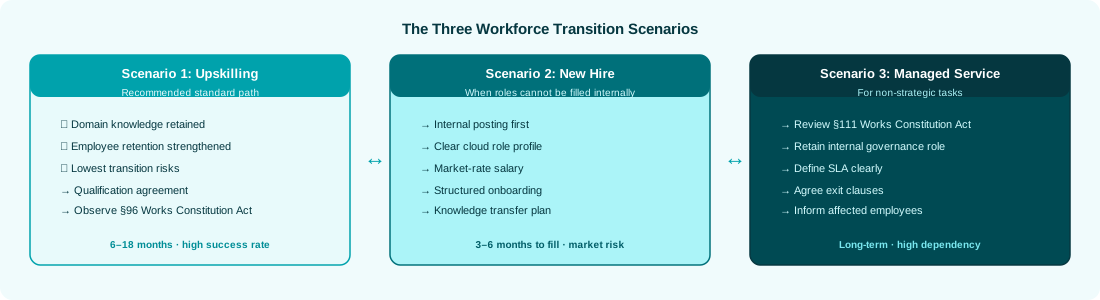
The most common and most recommended path. Experienced employees know the business domain, the processes, and the internal culture. Cloud knowledge is learnable — domain knowledge is not.
What a qualification agreement contains:
Role transitions that are common in practice:
| Starting role | Target role | Typical transition period |
|---|---|---|
| System administrator | Platform Engineer | 9–12 months |
| Network administrator | Cloud Network Engineer | 6–9 months |
| Storage administrator | Cloud Storage & Backup Specialist | 6–9 months |
| IT project manager | Cloud Product Owner | 12–18 months |
| Application developer | Cloud-Native Developer | 4–8 months |
| IT controller | FinOps Analyst | 6–12 months |
Some roles do not yet exist in the organisation and cannot be filled internally. This frequently applies to Platform Architects, Site Reliability Engineers, and DevSecOps specialists.
What applies in the new hire process:
For areas without strategic differentiation, the decision may be made to permanently transfer tasks to a managed service provider. This has employment law consequences that must be clarified early.
What must be clarified:
Mistake 1: Informing too late. If employees hear rumours about the cloud migration before receiving official information, you lose trust that is difficult to regain. Communicate early, even when not all questions can yet be answered.
Mistake 2: Treating qualification as optional. Anyone who regards upskilling as a nice-to-have ends up with neither qualified teams nor a viable cloud environment. Qualification is investment, not cost.
Mistake 3: Describing roles too technically. A job description that consists exclusively of lists of technologies puts off experienced employees whose domain competence is not reflected in a row of certifications.
Mistake 4: Measuring success only technically. Anyone who measures transformation success exclusively by SLAs and deployment frequency notices too late when teams are overloaded, frustrated, or have disengaged internally.
Inventory of current roles — Which skills exist, which are missing? Where are there overlaps with future cloud roles?
Early involvement of the works council — Inform proactively before decisions are fixed. Present the qualification plan as a central element.
Individual conversations — Every affected person deserves a personal conversation about their development perspective, not a generic email.
Conclude qualification agreements — In writing, with timeline and resources. Not as a control instrument, but as a mutual commitment.
Structurally anchor learning time — Without explicitly protected learning time, qualification does not happen. Day-to-day operations systematically crowd out learning.
Make progress visible — Regular check-ins and publicly visible successes (certifications, new project responsibilities) reinforce commitment.
The qualification content for the roles described here is developed in the Cloud Empowerment chapter as the Six-Track model. Workforce transition and qualification planning are two sides of the same coin — the organisational framework here, the learning content there.
Involve the works council as a partner under Section 87 of the German Works Constitution Act, structure legally sound written qualification agreements, and protect learning time.
Cloud transformations do not fail because of Kubernetes. They fail because people do not know what role they are supposed to play in the new world, whether their job is secure, and whether their experience still counts.
A workforce transition is not an HR project running in parallel with the technical migration. It is a leadership task that begins before the first technical step and does not end after go-live.
The most common and most recommended path. Experienced employees know the business domain, the processes, and the internal culture. Cloud knowledge is learnable — domain knowledge is not.
What a qualification agreement contains:
Role transitions that are common in practice:
| Starting role | Target role | Typical transition period |
|---|---|---|
| System administrator | Platform Engineer | 9–12 months |
| Network administrator | Cloud Network Engineer | 6–9 months |
| Storage administrator | Cloud Storage & Backup Specialist | 6–9 months |
| IT project manager | Cloud Product Owner | 12–18 months |
| Application developer | Cloud-Native Developer | 4–8 months |
| IT controller | FinOps Analyst | 6–12 months |
Some roles do not yet exist in the organisation and cannot be filled internally. This frequently applies to Platform Architects, Site Reliability Engineers, and DevSecOps specialists.
What applies in the new hire process:
For areas without strategic differentiation, the decision may be made to permanently transfer tasks to a managed service provider. This has employment law consequences that must be clarified early.
What must be clarified:
Mistake 1: Informing too late. If employees hear rumours about the cloud migration before receiving official information, you lose trust that is difficult to regain. Communicate early, even when not all questions can yet be answered.
Mistake 2: Treating qualification as optional. Anyone who regards upskilling as a nice-to-have ends up with neither qualified teams nor a viable cloud environment. Qualification is investment, not cost.
Mistake 3: Describing roles too technically. A job description that consists exclusively of lists of technologies puts off experienced employees whose domain competence is not reflected in a row of certifications.
Mistake 4: Measuring success only technically. Anyone who measures transformation success exclusively by SLAs and deployment frequency notices too late when teams are overloaded, frustrated, or have disengaged internally.
Inventory of current roles — Which skills exist, which are missing? Where are there overlaps with future cloud roles?
Early involvement of the works council — Inform proactively before decisions are fixed. Present the qualification plan as a central element.
Individual conversations — Every affected person deserves a personal conversation about their development perspective, not a generic email.
Conclude qualification agreements — In writing, with timeline and resources. Not as a control instrument, but as a mutual commitment.
Structurally anchor learning time — Without explicitly protected learning time, qualification does not happen. Day-to-day operations systematically crowd out learning.
Make progress visible — Regular check-ins and publicly visible successes (certifications, new project responsibilities) reinforce commitment.
The qualification content for the roles described here is developed in the Cloud Empowerment chapter as the Six-Track model. Workforce transition and qualification planning are two sides of the same coin — the organisational framework here, the learning content there.
Build a durable learning organization through protected sandboxes, cloud guilds, and a cloud champions network.
Cloud technology is bought. Cloud capability is built. The difference between organisations that complete cloud transformation successfully and those that look back frustrated after 18 months is almost always the same question: did the people learn to genuinely use the platform?
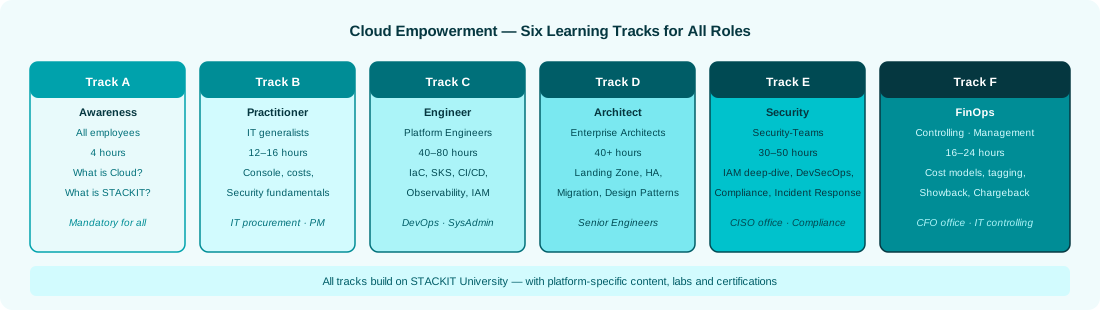
This chapter shows you how to develop cloud capability systematically — with a structured learning architecture of six tracks, a clear qualification strategy for all roles, and an organisational learning infrastructure that does not end with the project.
Know the skill gap
A structured assessment of existing and required cloud capabilities — differentiated by role, with concrete prioritisations for the start.
Six learning paths
From cloud awareness for all employees to specialised tracks for Security, FinOps and Architecture — every person gets the learning path that fits their role.
STACKIT University & certifications
STACKIT’s own learning platform, recommended external certifications by track, and a realistic training budget for mid-sized organisations.
Learning organisation
Sandbox environments for experimentation, Cloud Guilds as Communities of Practice, and the Cloud Champions network as a multiplier into the teams.
When organisations invest in the qualification of their employees, they send a clear message: you are part of this transformation, not its victim. This message is the strongest change management lever an IT leader has.
People who know that their capability is actively being developed are more open to change. They become ambassadors instead of sceptics. They bring knowledge into the teams that no external consultant will ever know better: their own organisation, its history, its weaknesses — and its strengths.
Cloud Empowerment is the practical implementation of cultural change and lays the foundation for all technical adoption topics.
Systematically capture existing and missing competencies to define individual, role-based training paths.
Without a skill gap analysis, the result is a one-size-fits-all training programme that is too specific for some and too general for others. The analysis provides the foundation for role-specific learning paths and realistic training budgets.
A complete inventory of all IT roles and their cloud requirements:
| Role domain | Typical positions | Cloud responsibilities | Number of people |
|---|---|---|---|
| Platform Engineering | Sysadmins, platform engineers | IaC, landing zone, managed services | [number] |
| Application Development | Software developers, DevOps | CI/CD, containers, cloud-native patterns | [number] |
| Security & Compliance | Security analysts, CISO office | IAM, policy-as-code, DevSecOps | [number] |
| Data & Analytics | Data engineers, BI analysts | Managed databases, object storage | [number] |
| Operations & SRE | IT operations, SRE | Observability, incident response | [number] |
| FinOps & Controlling | IT controllers, procurement | Cloud economics, tagging, showback | [number] |
| Management & Architecture | IT leadership, enterprise architects | Strategy, governance, cost ownership | [number] |
Competencies are assessed in four fields on a 1–4 scale for each role domain:
Rating scale:
| Competency field | Assessment questions |
|---|---|
| Cloud fundamentals | Cloud service categories, STACKIT portfolio, shared responsibility |
| Technical skills | Writing IaC, operating Kubernetes, configuring networks |
| Security & compliance | IAM concepts, least privilege, GDPR requirements |
| Cloud economics | Cost models, tagging standards, optimisation levers |
The output of the assessment is a gap matrix — for each role domain the delta between current state and target competency:
| Role domain | Cloud fundamentals | Technical skills | Security | Economics | Priority |
|---|---|---|---|---|---|
| Platform Engineering | Current: 2 / Target: 4 | Current: 1 / Target: 4 | Current: 2 / Target: 3 | Current: 1 / Target: 2 | 🔴 High |
| App Development | Current: 2 / Target: 3 | Current: 2 / Target: 3 | Current: 1 / Target: 3 | Current: 1 / Target: 2 | 🔴 High |
| Security | Current: 2 / Target: 3 | Current: 1 / Target: 3 | Current: 2 / Target: 4 | Current: 1 / Target: 2 | 🟡 Medium |
| IT Operations | Current: 2 / Target: 3 | Current: 2 / Target: 3 | Current: 2 / Target: 2 | Current: 1 / Target: 2 | 🟡 Medium |
| Controlling | Current: 1 / Target: 2 | Current: 1 / Target: 1 | Current: 1 / Target: 1 | Current: 1 / Target: 3 | 🟡 Medium |
| Management | Current: 1 / Target: 2 | Current: 1 / Target: 1 | Current: 1 / Target: 2 | Current: 1 / Target: 2 | 🟢 Low |
Option A: Self-assessment with calibration Each person rates themselves using the 1–4 scheme. The team lead then calibrates the assessments. Fast, but at risk of overestimation.
Option B: Structured interview A CCoE member or external trainer conducts 30-minute interviews with one person per role domain. Representative, but not comprehensive.
Option C: Technical assessment Short tasks (1–2 hours): write IaC, review an IAM policy, calculate a cost model. Objective, but time-intensive.
Recommendation for most organisations: Option A with team lead calibration for the initial assessment. After 6 months of training: Option C to measure progress.
The gap matrix feeds directly into the training model:
Run structured, role-based STACKIT University training tracks, from cloud awareness through architecture and security to FinOps.
Cloud competency is not a uniform quantity. A CIO needs strategic understanding, not Terraform knowledge. A platform engineer needs Terraform depth, not FinOps details. An IT controller needs cloud economics expertise, not Kubernetes knowledge.
Six role-specific tracks ensure that each person receives exactly the skills they need for their cloud responsibilities — no more, no less.
Target group: 100% of IT staff + relevant business units + management Duration: 4 hours (mandatory, within 6 months of adoption start) Format: Interactive e-learning course + optional live Q&A
Learning objectives:
STACKIT relevance: STACKIT University Track A covers these topics with STACKIT-specific context.
KPI: Track A completion rate — target: 100% within 6 months
Target group: IT staff without cloud specialisation, project managers, IT procurement Duration: 12–16 hours Format: Blended in-person/online course + first sandbox exercises
Learning objectives:
STACKIT relevance: STACKIT University Track B + hands-on lab in STACKIT sandbox
Target group: Platform engineers, sysadmins in transition, DevOps engineers Duration: 40–80 hours Format: Technical intensive course + project practical tasks
Learning objectives and content:
| Module | Content | Hands-on |
|---|---|---|
| IaC with Terraform | Terraform fundamentals, STACKIT Terraform Provider | Deploy VPC + VM |
| STACKIT SKS | Managed Kubernetes, create clusters, deploy workloads | App on SKS |
| Network configuration | VPC, subnets, firewall rules, hub-and-spoke | Landing zone network |
| CI/CD integration | GitHub Actions / GitLab CI with STACKIT | Build a pipeline |
| Observability | STACKIT Observability, logging, alerting | Configure an alert |
| IAM in practice | Service accounts, workload identity, RBAC | IAM setup |
Track C final project: Deploy a complete workload (web application + database) on STACKIT — with Terraform, in SKS, with CI/CD pipeline, with monitoring and tagging.
STACKIT relevance: STACKIT University Track C + CKA preparation + Terraform Associate preparation
Target group: Enterprise architects, senior cloud engineers, technical leads Duration: 40+ hours Format: Workshop format + architecture review cases
Learning objectives:
Target group: Security analysts, CISO office, compliance managers Duration: 30–50 hours Format: Technical course + compliance mapping workshop
Learning objectives:
STACKIT relevance: STACKIT IAM product training + CCSP preparation
Target group: IT controllers, CFO office, IT management Duration: 16–24 hours Format: Business-oriented seminar + dashboard workshop
Learning objectives:
STACKIT relevance: STACKIT Billing Dashboard Workshop + FinOps Foundation Practitioner preparation
| Month | Activity |
|---|---|
| Month 1 | Launch Track A for all IT staff; sandbox access for technical roles |
| Months 2–3 | Track C first cohort (platform engineers + DevOps) |
| Months 3–4 | Track B for IT generalists; Track E first cohort (security) |
| Months 4–6 | Track D for architects; Track F for controlling |
| Months 6–12 | Further cohorts, cloud guilds active, external certifications |
One-size-fits-all: A general cloud course for everyone wastes time.
Training without application: Track C without an immediately following practical project in the sandbox evaporates within 2 weeks.
Training under time pressure: Instructing teams to complete training while maintaining 100% production load reliably results in training not happening.
Structurally verify cloud capabilities and secure training progress through standardized certification exams.
STACKIT University is STACKIT’s proprietary learning platform with product-specific courses, hands-on labs and platform-specific certifications.
What STACKIT University covers:
Integration into the training tracks:
Recommendation: Set up STACKIT University access for all IT staff from day 1 of the adoption phase. Cost: part of the STACKIT partnership agreement, often at no additional charge.
Certifications carry a dual value:
Recommendation: Celebrate certification successes internally (intranet, all-hands) — this motivates others and makes the transformation visible.
Tobias M.Head of STACKIT Cloud Framework · STACKITOwnerActive 12 of the last 12 weeks · 168 updatesSTACKITwww.linkedin.com/in/tobias-müller-011304172??Name not publicThe Cloud Framework team knows who this is. The name is not shown on the site.Contributed in STACKITTobias M.Tobias M.Head of STACKIT Cloud Framework · STACKITOwnerActive 12 of the last 12 weeks · 168 updatesSTACKITwww.linkedin.com/in/tobias-müller-011304172
· Sep 22, 2026