STACKIT experience
Does the MSP have demonstrable experience with STACKIT? Are there reference customers from similar industries? STACKIT-certified partners provide a structured entry point.
Many organisations decide to outsource parts of their cloud operations to a managed service provider (MSP). The decision is often correct — operations become more reliable, and internal teams can focus on strategic topics.
What is frequently underestimated: governing the MSP relationship is itself a demanding task. Anyone who does not build a structured steering process gradually loses control of their own cloud environment — without noticing.
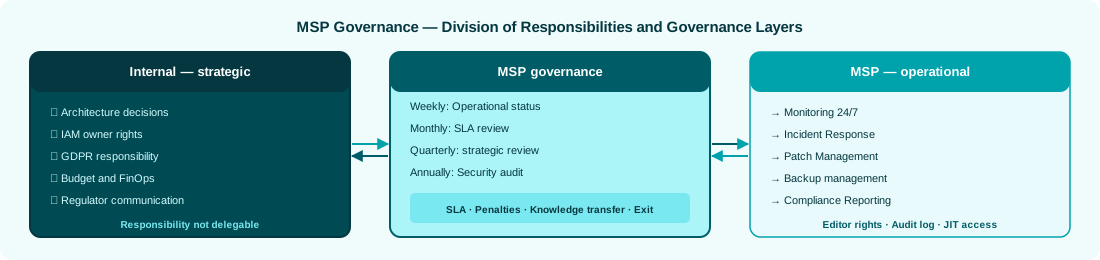
Operational tasks MSPs frequently assume:
What should remain internal:
An MSP contract must cover more than price and scope. Critical contract elements:
Service Level Agreement (SLA):
Penalties and credits: Without economic consequences for SLA violations, SLAs have little steering effect. Typical: credits of 10–30% of the monthly service fee for demonstrated SLA shortfall.
Subcontractor provisions: Which tasks may the MSP further delegate? Every sub-delegation must be transparent and must meet the same data protection and security standards — relevant for GDPR Art. 28 para. 4.
Exit provisions: How is the handover to another provider or back to the internal team governed? Timelines, knowledge transfer obligations, documentation handover, access return.
The most common governance error: the MSP has too many rights, for too long.
Best practice for MSP access:
The internal IAM team (or CCoE) retains owner rights on all projects. The MSP operates with editor rights in defined scopes — never with owner rights.
MSP governance requires structure. Without regular review, the relationship drifts in a direction that the client does not notice — until there is a problem.
| Review format | Frequency | Participants | Agenda |
|---|---|---|---|
| Operational status call | Weekly | IT lead + MSP delivery | Open incidents, tickets, ongoing changes |
| SLA review | Monthly | CIO + MSP management | SLA report, deviations, improvement measures |
| Strategic review | Quarterly | Board + MSP leadership | Roadmap, contract adjustments, make-or-buy |
| Security audit | Annual | CISO + MSP security | Penetration test results, certifications, incident report |
MSP lock-in is often not contractual but knowledge-based: the internal team no longer knows how its own infrastructure functions.
Documentation requirements:
STACKIT experience
Does the MSP have demonstrable experience with STACKIT? Are there reference customers from similar industries? STACKIT-certified partners provide a structured entry point.
Compliance expertise
Does the MSP understand the regulatory requirements of your sector? GDPR, TISAX, BAIT, KRITIS — an MSP without compliance expertise is unsuitable for regulated environments.
Transparent processes
Can the MSP present their incident response process, change management procedures and security concept? Providers who evade these questions are a risk.
Exit readiness
A reputable MSP actively shapes the exit clause — because it knows that a good relationship is the best client retention. Anyone who blocks exit provisions is creating dependency.
Define scope — What is outsourced, what remains internal? In writing, as the basis for the tender.
MSP tender or selection — At least three offers, a structured evaluation matrix, reference conversations with existing clients.
Contract negotiation — SLAs, penalties, subcontractor provisions, exit clause, GDPR data processing agreement. Legal counsel specialised in cloud contracts is recommended.
Implement access concept — Set up MSP accounts, define permission scope, activate audit logging, establish review process.
Establish review rhythm — Weekly, monthly and quarterly reviews anchored in the calendar. Create agenda templates.
Agree documentation requirements in writing — What does the MSP deliver, in what format, at what interval? As a contractual component, not a verbal assurance.
The SLA requirements for MSPs are derived from the DR tier classifications of the affected workloads. The internal Service Catalogue defines which services IT delivers itself and which the MSP assumes.