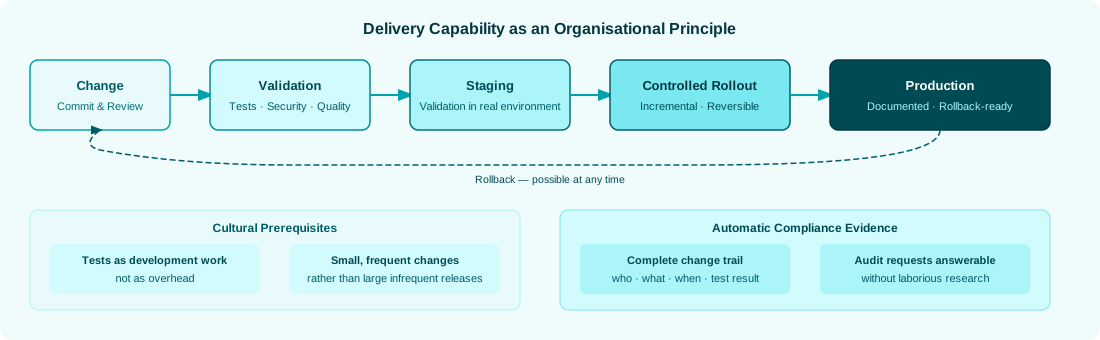
Continuous Integration and Continuous Deployment are not tools. They are organisational principles — a decision about how an organisation develops, validates, and operates software.
The core idea is simple: instead of deploying changes to production infrequently, manually, and riskily, they are delivered frequently, automatically, and in a controlled manner. Every change goes through the same quality checks. Every change is documented. Every change can be reversed.
Organisations that take this path don’t deliver faster because they work less carefully. They deliver faster because they have automated the care.
Before a CI/CD pipeline is built, two cultural prerequisites must be in place. Without them, any technical implementation will fail against the organisation.
Tests are not optional additional work. A pipeline that checks automatically can only be as good as the tests it runs. If tests are seen as an annoying obligation to get through as quickly as possible, the pipeline becomes a formality — a green light that means nothing. Tests must be understood as an integral part of development work, not as overhead at the end.
Small, frequent changes rather than large, infrequent releases. The greatest risks in software changes come from the size of the change: the larger the package, the harder the debugging, the greater the impact when something goes wrong. CI/CD works best when teams learn to decompose changes into smaller, deliverable units. This is a way of working that must be learned — it is not natural for teams accustomed to monthly releases.
Quality gates in a pipeline are decisions, not technical defaults. What must pass before a
change reaches production? Which tests are mandatory? Which security checks are non-negotiable?
Setting these gates consciously — and documenting why they were set — is more important than the
technical configuration.
Who is responsible for pipeline operations?
A pipeline is itself software — it must be maintained, updated, and analysed quickly when
problems occur. If ownership is unclear, problems are ignored or bypassed. The Platform Team
should own the pipeline infrastructure; individual teams own the tests and checks that their
changes pass through.
How are failing pipelines handled?
How the organisation deals with red pipelines is a cultural question. Are failures fixed
immediately? Or do they accumulate because “the test has been failing for weeks but it was never
a real problem”? A failing pipeline that no longer alarms anyone has stopped providing safety.
What happens when something goes wrong?
A rollback process must be defined before it is needed — not in the moment when a critical
problem has occurred. How long does a rollback take? Who can trigger one? Which teams must be
informed? Answering these questions calmly in advance is much better than answering them under
pressure.
The greatest danger at deployment is irreversibility: a change that causes a problem, and no fast path back. Deployment strategies address this through controlled introduction of changes.
The simplest strategy — rolling changes out progressively to a growing proportion of users — makes it possible to detect problems before all users are affected. If something goes wrong, five percent of users are affected, not a hundred. Rollback is a decision, not a catastrophe.
A more sophisticated strategy — running a new version in parallel with the old one until the new version has proven it works — eliminates the risk of outage entirely. If the new version shows problems, the switch is made back to the old one. No user experienced an outage.
Which strategy is right for which context depends on the criticality of the workload and the maturity of the team. A highly critical production environment needs different safety mechanisms than an internal tool.
An often-overlooked value of CI/CD is documentation. Every change that runs through a pipeline leaves evidence: what was changed, when, by whom, what checks were performed, was the result positive?
For organisations under regulatory requirements, this is not a side effect — it is a compliance asset. Instead of laboriously assembling audit requests from logs and memory, there is a complete, immutable trail for every production change. This substantially reduces the effort of audits.
Choose a single pilot: Identify a workload where the team is motivated and willing to take risks. Not a core production service, but an important, non-critical one. Build the first pipeline together with the team — so the team understands and owns the pipeline, not just uses it.
Define quality gates: What should this pipeline check? What does it block? These decisions are discussed with the team and documented. No automatic adoption of defaults — every gate has a reason.
Evaluate the pilot phase: What worked well? What created friction? What should have been prevented? This review is the foundation for the broader rollout and should be conducted honestly.
Rollout with support, not pressure: Bring in more teams — with support, not mandate. Teams that experience pipelines as a constraint build workarounds. Teams that experience pipelines as protection maintain them.
Measure quality and learn: How long does a change take from development to production? How often does the pipeline fail and why? These metrics — not as a control mechanism, but as a learning source — show where investment should go.
CI/CD and Infrastructure-as-Code are not separate topics. In a mature environment, infrastructure changes are treated exactly like application changes: they run through a pipeline, are checked automatically, and changes to production environments happen exclusively through this approved process. This interplay — application code and infrastructure code in the same quality processes — is the hallmark of a mature cloud operating culture.
External link
You are leaving the trail
This link goes to an external site outside STACKIT. We do not vet third-party content or downloads, so follow it only if you trust the source.