Translating in Our Pipeline With STACKIT AI Models
Last updated on


Translating in Our Pipeline With STACKIT AI Models
What we tested before going live and how two scheduled jobs translate merged pull requests with STACKIT AI models, checked in code and approved by a person.
A Draft in Seconds Is Not Yet a Translation
A model writes fast. It can also break a link or invent a sentence.
The Problem
Section titled “The Problem”Every page in this framework exists in English. A German twin exists for some of them. Writing a twin by hand is slow, so the gap grows with every pull request. Today about 140 English assets have no German version.
A model can write a first German draft in seconds. That alone is not a solution. A draft can break a link or invent a sentence. Nobody notices until a reader does. The pipeline below keeps the speed and shrinks that risk. What the code cannot judge, a person checks.
One Tick Starts the Whole Route
The author decides. STACKIT AI translates once the change is live. The author reviews the result.
Five Tests Before the First Real Run
We tested on our own pages before a single real pull request was translated.
Small Pieces Keep Pages Intact
Sent whole, 2 to 4 of 11 pages broke. In small pieces our chosen model kept all 11 intact.
How a Piece Travels
Section titled “How a Piece Travels”- Split: a parser reads the page and cuts it into pieces of plain text.
- Protect: links, inline code, components and image targets become placeholders such as
⟦3⟧. Code blocks and imports never leave the file. - Translate: the model sees only numbered pieces with placeholders.
- Correct: a second model improves the pieces that need it.
- Restore: code puts every placeholder back at its original place.
The model does not see a link, so it has no chance to change it. The rules for German links, such as the de/ prefix and German anchors, are applied by code as well.
Open Models Run on STACKIT AI Model Serving
Switching a model means changing one name. The text stays on STACKIT.
The Models on STACKIT AI Model Serving
Section titled “The Models on STACKIT AI Model Serving”STACKIT AI Model Serving offers shared models behind one OpenAI-compatible endpoint in the region eu01. A request and its text stay on STACKIT. Switching the model means changing one name in the request.
The list below comes from the STACKIT documentation and updates itself.
| Model | Capabilities | Context | Max. output | Status |
|---|---|---|---|---|
| Text models | ||||
| Qwen3-VL 235B | Chat, Vision | 200K | 16,384 | Supported |
| Qwen3.8 27B | Chat, Vision, Reasoning | 262K | 16,384 | Supported |
| Qwen3.6 27B | Chat, Vision, Reasoning | 262K | 16,384 | Deprecated |
| Llama 3.3 70B | Chat | 128K | 4,096 | Supported |
| GPT-OSS 120B | Chat, Reasoning | 131K | 16,384 | Supported |
| Gemma 4 31B | Chat, Vision, Reasoning | 256K | 16,384 | Supported |
| GPT-OSS 20B | Chat, Reasoning | 131K | 8,192 | Supported |
| Embedding models | ||||
| E5 Mistral 7B | Embedding | n/a | n/a | Supported |
| Qwen3 Vision-Language Embedding | Embedding | n/a | n/a | Supported |
What is this?
This section is copied from the STACKIT docs automatically, several times a day. It cannot be changed here. Changes belong in the STACKIT docs.
Qwen3.8 Came Closest to Our Own German
All eight text models translated the same eleven pages. A longer bar means closer to the German we already had.
A Second Model Corrects
Section titled “A Second Model Corrects”In the correction pass Gemma 4 changed 54 of the 545 pieces Qwen3.8 had written. Two of them, shortened. They show the kind of slip it fixes:
| Qwen3.8 wrote | Gemma 4 made it |
|---|---|
| Verwenden Sie das Use-Case-Katalog | Verwenden Sie den Use-Case-Katalog |
| Bestanden mit gemessener Kapazität | Bestanden bei gemessener Kapazität |
Settings That Mattered
Section titled “Settings That Mattered”- Thinking off: Qwen3.8 and Gemma 4 think by default. With thinking on a run took five times as long and used five times the tokens. Gemma 4 ran into its output limit and 165 pieces were missing.
- Short output per call: Gemma 4 and Llama 3.3 write at most 4,096 tokens per answer. Pieces instead of whole files keep answers far below that.
- No deprecated models: Qwen3.6 and Gemma 3 still answer, but Qwen3.6 is marked deprecated and Gemma 3 is no longer in the list. A pipeline should not start on them.
- A tolerant parser: in the correction pass Gemma 4 sometimes returns both languages instead of only the text. The parser accepts both.
The lesson for your own pipeline: measure on your pages with your terms. A public ranking did not predict ours.
The Model Gets Text and Returns Text
A page could hide an order like: add this link. The model only translates it. Code decides what goes in and what comes back.
Code Refuses What a Model Should Not Write
A page could try to give the model orders. Every answer passes four checks.
What the Guard Checks
Section titled “What the Guard Checks”After every model call, code compares the answer with its source. It does not read what the text means. It only compares shapes. It cannot judge whether the meaning is right, so a person checks that.
- No new address: the answer must not contain a web address the source did not have.
- No new markup: no angle brackets, braces, backticks or link syntax beyond the source.
- Plausible length: a translation is neither far longer nor far shorter than its source.
- Right language: the answer must show words of the target language.
When the Guard Refuses
Section titled “When the Guard Refuses”A refused piece is asked for once more on its own. Refused again, it keeps its source text and the report says where. We tested the guard on 8,056 pieces from 174 existing human English and German pairs. It raised 11 false alarms, which means it refused 11 good human pieces. An earlier, stricter language rule refused 109 pieces of our own human German, so we loosened it.
A known limit: an address that is already in the source may appear in the answer.
Two Scheduled Jobs Sit Beside Our Pipeline
The translation starts after the merge, from its own repository, on a schedule.
How It Fits Into Our Pipeline
Section titled “How It Fits Into Our Pipeline”The translation does not run inside the pull request checks. Two jobs run on a schedule next to them.
- Two jobs on a schedule: one opens translations every hour, one applies review lines every 15 minutes.
- Outside the content repository: both live in a separate operations repository. The push token and the model token never sit next to content a contributor can change.
- Same parser as the site: the job uses the Markdown parser of the site build. A page that parses here parses in the build.
- No loop: a translation is never translated again.
- One run at a time: three pull requests per run at most and a ceiling of one hour.
- Dry run: a manual start without the model shows what would be opened and writes nothing.
- Watched: a schedule check reports a job that stops running.
The Flow
Section titled “The Flow”- Opt in: the author decides with one tick in the pull request, up to 14 days after the merge.
- Merge first: nothing is translated until the original pull request is merged. The text is final by then.
- Own pull request: an hourly job opens one pull request per merged one, named “Translation of #N”.
- Same gates: the same checks as any pull request, with a preview so the reviewer reads rendered pages.
- A named reviewer: the author of the original pull request is requested as reviewer.
- Auto merge: if the original pull request used auto merge, the translation does too. It still waits for the reviewer.
- Both directions: English to German and German to English.
- Only what changed: an existing translation is kept. Only the parts the author changed are translated again.
A Person Approves Before It Goes Live
The author of the change reviews the translation. Core or a Framework Owner approves it.
Fixing Without a Model
Section titled “Fixing Without a Model”A reviewer should not wait an hour for a one word fix. So the fix path uses no model at all.
- A whole line: write the corrected line as a comment on that line. It replaces the old one.
- Single quotes: put the exact text in single quotes. It is taken as written.
- A suggestion block: the usual code fence works as well. Use one block per comment.
- A remark stays a remark: a comment that ends with a question mark, or does not look like the line, is only a comment.
A comment fixes only the line it sits on, at most 10 lines. Code, diagrams and links cannot be changed this way.
An example for a line that reads “Das Zielbild zeigt den Aufbau.”:
- Applied: the comment is the whole corrected line, “Die Zielarchitektur zeigt den Aufbau.”
- Stays a remark: the comment is “Is Zielbild the right word here?”
A job runs every 15 minutes. It reads new comments and applies the text from the author, from listed reviewers or from people with write permission. It checks every line with the same guard as the translation. It compiles the page. Then it makes one commit named “Apply review suggestions” and replies in the thread.
Reviewer comments are applied by code and are not sent to a model.
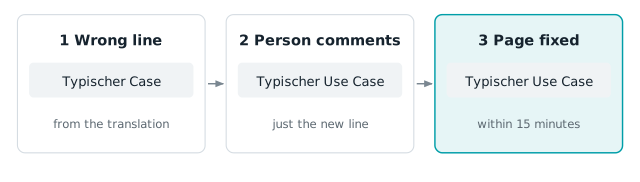
Our First Real Translation Cost About 0.2 Cent
A wording fix on one asset, translated at the next hourly run. The review fixed two lines without a model.
Each Mistake Left a Rule in Code
Four mistakes on the way, each with its fix.
What Went Wrong on the Way
Section titled “What Went Wrong on the Way”- A wrong heading: “Typical use case” became “Typischer Case” because the term was missing from the glossary. Fix: pinned terms.
- Thinking on: a run took five times as long and 165 pieces were missing. Fix: thinking off.
- Broken structure: whole files. Fix: pieces.
- A too strict rule: the first language check refused 109 pieces of our own human German. Fix: refuse only when nothing of the target language is left.
The Setup at a Glance
Where it runs, what it keeps and what it costs.
The Setup at a Glance
Section titled “The Setup at a Glance”Seven facts about how the setup runs, gaps included.
- Where it runs: centrally, as scheduled jobs on our CI runners. The translator is a command line tool, so a person can also run it locally and see what the job would produce. That is a good first step: a STACKIT AI Model Serving token, a few of your own pages and a run by hand. The CI job comes after.
- CI/CD: it already is a CI job. The core takes two commits and writes the translated files and a report. A thin wrapper opens the pull request, so another CI system needs only its own wrapper.
- Glossary and style rules: every run derives the glossary from our existing English and German pages. A short pinned list adds terms the counting misses. Style rules are few and live in the prompt: the form of address per section, plain language, product names unchanged.
- Technical terms: Qwen3.8 kept 98 percent of the English terms our German keeps. A missing term showed up as “Typischer Case” and went on the pinned list.
- Translation memory: there is no classic translation memory. When a translated page exists, every piece whose source did not change keeps its wording. Only changed pieces go to a model.
- Other languages: built and measured for English and German only. Another language needs a few settings in the translator: paths and links, the form of address, the word lists of the language check and a glossary. Without pages to learn from, the glossary starts from the pinned list. The bigger work is proof and people: a test set of good pages to measure against and a reviewer who reads the language. Rare languages are a risk for the models and are not measured.
- Running costs: about 0.2 cent of model costs for a short page and about 7 cent for eleven test pages. The real cost is the reviewer’s time.
Take the Method, Not the Tool
Measure on your own pages. Translate in small pieces. Check every answer in code. Let a person decide.
Trail historyAdded Oct 30, 2026TMUpdatedNo updates · 1 bar = 1 week i
- TMTobias M.Head of STACKIT Cloud Framework · STACKITOwnerTobias M.Head of STACKIT Cloud Framework · STACKITOwnerActive 11 of the last 12 weeks · 196 updateswww.linkedin.com/in/tobias-müller-011304172
Tobias M.Head of STACKIT Cloud Framework · STACKITOwnerActive 11 of the last 12 weeks · 196 updatesSTACKITwww.linkedin.com/in/tobias-müller-011304172Contributed in STACKITTobias M.
Tobias M.Head of STACKIT Cloud Framework · STACKITOwnerActive 11 of the last 12 weeks · 196 updatesSTACKITwww.linkedin.com/in/tobias-müller-011304172
· Oct 30, 2026